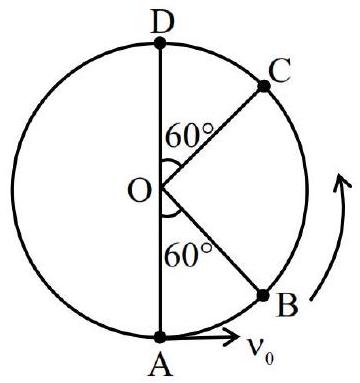
A bob of mass m is suspended at a point O by a light string of length l and left to perform vertical motion (circular) as shown in figure. Initially, by applying horizontal velocity v0 at the point 'A', the string becomes slack when the bob reaches at the point 'D'. The ratio of the kinetic energy of the bob at the points B and C is ______.
(A)2✓ Correct
(B)1
(C)4
(D)3
Answer: (A)
Solution
Let the string length be ℓ. Point A is at the bottom, D at the top (height 2ℓ above A), and B, C sit symmetrically at 60° steps up from A: B is 60° up from A, and C is a further 60° up (equivalently 60° short of D). The height of a point at angle θ measured from the bottom is ℓ(1−cosθ), giving
hB=ℓ(1−cos60°)=2ℓ,hD−hC=ℓ(1−cos60°)=2ℓ.
The string goes slack at D, so gravity alone supplies the centripetal force there: mg=ℓmvD2⇒vD2=gℓ.
Energy conservation from A to D (height gain 2ℓ):
vA2=vD2+2g(2ℓ)=gℓ+4gℓ=5gℓ.
Kinetic energy at B, from energy conservation with A (height hB=ℓ/2):
KEB=21mvA2−mghB=21m(5gℓ)−mg2ℓ=2mgℓ.
Kinetic energy at C, from energy conservation with D (height drop ℓ/2 from D down to C):
KEC=21mvD2+mg2ℓ=21mgℓ+mg2ℓ=mgℓ.
The ratio is
KECKEB=mgℓ2mgℓ=2.
JEE Main · 2025 · 22 Jan 2025 · Shift 1 · Single correct option