JEE Advanced · 2006 · 09 Apr 2006 · Chemical Thermodynamics

WhatsApp Email
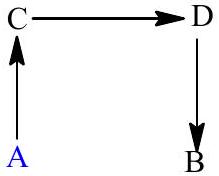
The direct conversion of A to B is difficult, hence it is carried out by the following shown path:

Given e.u.
e.u.
e.u.
where e.u. is entropy unit then is
  1. (A)+100 e.u.
  2. (B)+60 e.u.✓ Correct
  3. (C)-100 e.u.
  4. (D)-60 e.u.

Answer: (B)

Solution

Entropy is a state function, so the entropy change is path-independent. Using the given path: . Substituting: e.u.

JEE Advanced · 2006 · 09 Apr 2006 · Single correct option

More JEE Advanced questions on Chemical Thermodynamics

  1. An ideal gas (0.5 mol), initially at 2 bar pressure, is compressed at a constant temperature of 600 K in two steps : first against a constant external pressure of P bar , and then against constant external pressure of 8 bar. At each step, the compression is st …
    JEE Advanced 2026View solution →
  2. List-I contains various physical/chemical processes, and List-II contains combinations of changes in enthalpy and entropy . Match each entry in List-I to appropriate entry in List-II, and choose the correct option.

    | List-I | | List …
    JEE Advanced 2026View solution →
  3. Considering ideal gas behavior, the expansion work done (in kJ) when 144 g of water is electrolyzed completely under constant pressure at 300 K is ____.

    Use: Universal gas constant ; Atomic mass (in amu): …
    JEE Advanced 2025View solution →
  4. Consider the following volume-temperature (V - T) diagram for the expansion of 5 moles of an ideal monoatomic gas.

    (see diagram)

    Considering only P-V work is involved, the total change in enthalpy (in Joule) for the transformation of state in the sequence …
    JEE Advanced 2024View solution →
  5. The entropy versus temperature plot for phases and at 1 bar pressure is given.
    and are entropies of the phases at temperatures T and 0 K, respectively.

    (see diagram)

    The transition temperature for to …
    JEE Advanced 2023View solution →
  6. The entropy versus temperature plot for phases and at 1 bar pressure is given.
    and are entropies of the phases at temperatures T and 0 K, respectively.

    (see diagram)

    The transition temperature for to …
    JEE Advanced 2023View solution →