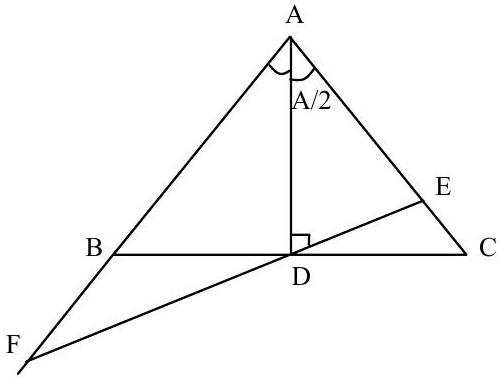
Internal bisector of ∠A of triangle ABC meets side BC at D. A line drawn through D perpendicular to AD intersects the side AC at E and the side AB at F. If a, b, c represent sides of △ABC then
(A)AE is HM of b and c✓ Correct
(B)AD=b+c2bccos2A✓ Correct
(C)EF=b+c4bcsin2A✓ Correct
(D)the triangle AEF is isosceles✓ Correct
Answer: (A), (B), (C), (D)
Solution
Using the angle bisector property and area considerations:
Area of △ABC= Area of △ABD+ Area of △ACD:
21bcsinA=21c⋅ADsin2A+21b⋅ADsin2A
bcsinA=AD(b+c)sin2A
Using sinA=2sin2Acos2A:
2bcsin2Acos2A=AD(b+c)sin2A
AD=b+c2bccos2A
Since EF⊥AD:
AE=ADsec2A=b+c2bc
This is the harmonic mean of b and c.
For EF: Since D is the midpoint of EF (by symmetry about the angle bisector):
EF=2DE=2⋅ADtan2A=b+c4bcsin2A
Since AD is the perpendicular bisector of EF and also the angle bisector of ∠A, triangle AEF is isosceles with AE=AF.
All four options are correct.
JEE Advanced · 2006 · 09 Apr 2006 · One or more correct options