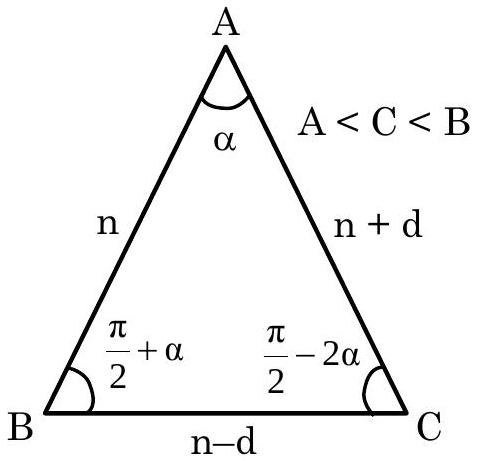
Consider an obtuse angled triangle ABC in which the difference between the largest and the smallest angle is 2π and whose sides are in arithmetic progression. Suppose that the vertices of this triangle lie on a circle of radius 1.
Consider an obtuse angled triangle ABC in which the difference between the largest and the smallest angle is 2π and whose sides are in arithmetic progression. Suppose that the vertices of this triangle lie on a circle of radius 1.
Let a be the area of the triangle ABC. Then the value of (64a)2 is
Answer: 1008
Solution
Let the sides be n−d,n,n+d (in AP) opposite to angles α,2π−2α,2π+α respectively (since largest - smallest = 2π).
Using sine rule with circumradius R=1:
n−d=2sinα,n=2sin(2π−2α)=2cos2α,n+d=2cosα
From the first and third: 2n=2sinα+2cosα, so n=sinα+cosα
But also n=2cos2α, so:
2cos2α=sinα+cosα
2(cos2α−sin2α)=sinα+cosα
2(cosα−sinα)=1
Squaring: 4(cos2α+sin2α−2sinαcosα)=1
4(1−sin2α)=1
sin2α=43
Then cos2α=±47. Since the triangle is obtuse, cos2α=47.