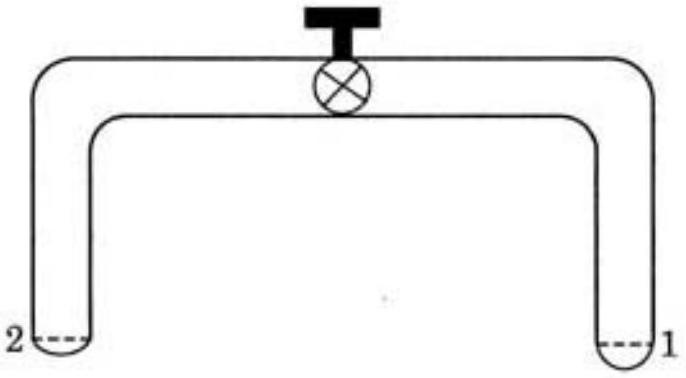
A glass tube of uniform internal radius (r) has a valve separating the two identical ends. Initially, the valve is in a tightly closed position. End 1 has a hemispherical soap bubble of radius r. End 2 has sub-hemispherical soap bubble as shown in figure. Just after opening the valve,
(A)air from end 1 flows towards end 2. No change in the volume of the soap bubbles
(B)air from end 1 flows towards end 2. Volume of the soap bubble at end 1 decreases✓ Correct
(C)no change occurs
(D)air from end 2 flows towards end 1. Volume of the soap bubble at end 1 increases
Answer: (B)
Solution
The excess pressure inside a soap bubble is ΔP=R4T, where T is surface tension and R is radius.
For the hemispherical bubble at end 1 (radius r): P1=P0+r4T
For the sub-hemispherical bubble at end 2 (radius R>r): P2=P0+R4T
Since R>r, we have P1>P2. Therefore, air flows from end 1 (higher pressure) to end 2 (lower pressure), and the volume of the bubble at end 1 decreases.
JEE Advanced · 2008 · 13 Apr 2008 · Paper 2 · Single correct option