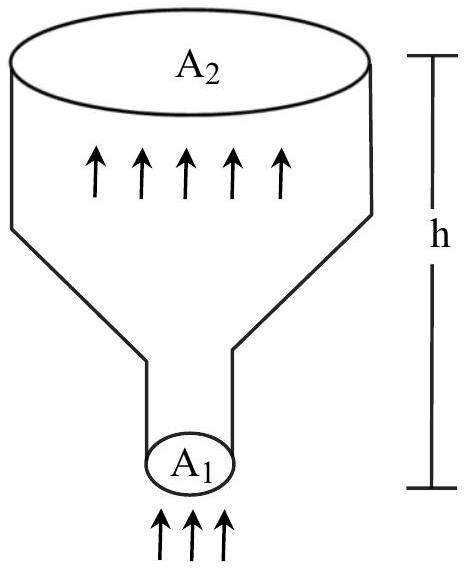
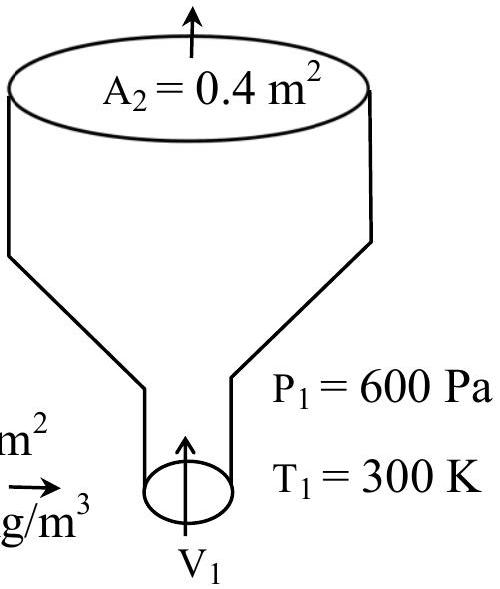
An ideal gas of density ρ=0.2kgm−3 enters a chimney of height h at the rate of α=0.8kgs−1 from its lower end, and escapes through the upper end as shown in the figure. The cross-sectional area of the lower end is A1=0.1m2 and the upper end is A2=0.4m2. The pressure and the temperature of the gas at the lower end are 600 Pa and 300 K, respectively, while its temperature at the upper end is 150K. The chimney is heat insulated so that the gas undergoes adiabatic expansion. Take g=10ms−2 and the ratio of specific heats of the gas γ=2. Ignore atmospheric pressure.
Which of the following statement(s) is(are) correct?
(A)The pressure of the gas at the upper end of the chimney is 300Pa.
(B)The velocity of the gas at the lower end of the chimney is 40ms−1 and at the upper end is 20ms−1.✓ Correct
(C)The height of the chimney is 590m.
(D)The density of the gas at the upper end is 0.05kgm−3.
Answer: (B)
Solution
From continuity: ρ1A1v1=0.8
v1=0.2×0.10.8=40m/s
For adiabatic process with γ=2:
P1P2=(T1T2)γ/(γ−1)=(300150)2=41
P2=150Pa
From ideal gas law: ρ∝P/T
ρ2=ρ1×P1P2×T2T1=0.2×41×2=0.1kg/m3
From continuity:
v2=ρ2A20.8=0.1×0.40.8=20m/s
Using energy conservation:
2P1/ρ1−2P2/ρ2=2v22−v12+gh
6000−3000=2400−1600+10h
h=360m
Only option (B) is correct.
JEE Advanced · 2022 · 28 Aug 2022 · Paper 1 · One or more correct options