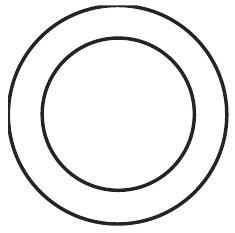
A bubble has surface tension S. The ideal gas inside the bubble has ratio of specific heats γ=35. The bubble is exposed to the atmosphere and it always retains its spherical shape. When the atmospheric pressure is Pa1, the radius of the bubble is found to be r1 and the temperature of the enclosed gas is T1. When the atmospheric pressure is Pa2, the radius of the bubble and the temperature of the enclosed gas are r2 and T2, respectively.
Which of the following statement(s) is(are) correct?
(A)If the surface of the bubble is a perfect heat insulator, then (r2r1)5=Pa1+r12SPa2+r22S
(B)If the surface of the bubble is a perfect heat insulator, then the total internal energy of the bubble including its surface energy does not change with the external atmospheric pressure.
(C)If the surface of the bubble is a perfect heat conductor and the change in atmospheric temperature is negligible, then (r2r1)3=Pa1+r14SPa2+r24S.✓ Correct
(D)If the surface of the bubble is a perfect heat insulator, then (T1T2)25=Pa1+r14SPa2+r24S.✓ Correct
Answer: (C), (D)
Solution
For a soap bubble, the pressure inside is Pgas=Pa+r4S (two surfaces).
(A) For adiabatic process: PVγ=const, giving (r2r1)3γ=Pa1+r14SPa2+r24S. With γ=35, this gives (r2r1)5, but the pressure should be r4S, not r2S. Incorrect.
(B) In an adiabatic process, internal energy changes. Incorrect.
(C) For isothermal process: PV=const, giving (r2r1)3=Pa1+r14SPa2+r24S. Correct.
(D) For adiabatic: P1−γTγ=const, giving (T1T2)5/3=(Pa1+r14SPa2+r24S)2/3, which simplifies to (T1T2)5/2=Pa1+r14SPa2+r24S. Correct.
JEE Advanced · 2022 · 28 Aug 2022 · Paper 2 · One or more correct options