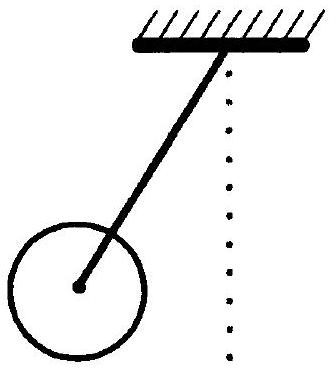
A metal rod of length 'L' and mass 'm' is pivoted at one end. A thin disk of mass 'M' and radius 'R' (< L) is attached at its center to the free end of the rod. Consider two ways the disc is attached: (case A) The disc is not free to rotate about its center and (case B) the disc is free to rotate about its center. The rod-disc system performs SHM in vertical plane after being released from the same displaced position. Which of the following statement(s) is (are) true?
(A)Restoring torque in case A= Restoring torque in case B✓ Correct
(B)Restoring torque in case A < Restoring torque in case B
(C)Angular frequency for case A > Angular frequency for case B.
(D)Angular frequency for case A < Angular frequency for case B.✓ Correct
Answer: (A), (D)
Solution
The restoring torque depends only on the gravitational forces and their moment arms, which are identical in both cases:
τ=mg2Lsinθ+MgLsinθ
So option A is correct.
The moment of inertia differs:
Case A: IA=3mL2+2MR2+ML2 (disc cannot rotate about its center)
Case B: IB=3mL2+ML2 (disc free to rotate, its rotational inertia about its center doesn't contribute)
Since IA>IB and ω=Iτ/θ, we have ωA<ωB (option D correct).
JEE Advanced · 2011 · 10 Apr 2011 · Paper 1 · One or more correct options