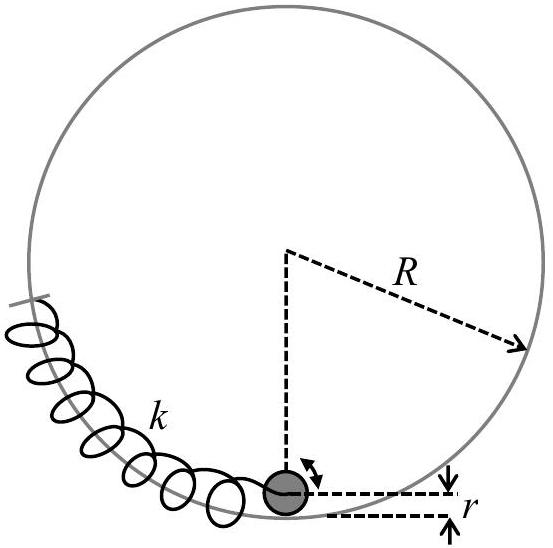
The center of a disk of radius r and mass m is attached to a spring of spring constant k, inside a ring of radius R>r as shown in the figure. The other end of the spring is attached on the periphery of the ring. Both the ring and the disk are in the same vertical plane. The disk can only roll along the inside periphery of the ring, without slipping. The spring can only be stretched or compressed along the periphery of the ring, following the Hooke's law. In equilibrium, the disk is at the bottom of the ring. Assuming small displacement of the disc, the time period of oscillation of center of mass of the disk is written as T=ω2π. The correct expression for ω is ( g is the acceleration due to gravity):
(A)32(R−rg+mk)✓ Correct
(B)3(R−r)2g+mk
(C)61(R−rg+mk)
(D)41(R−rg+mk)
Answer: (A)
Solution
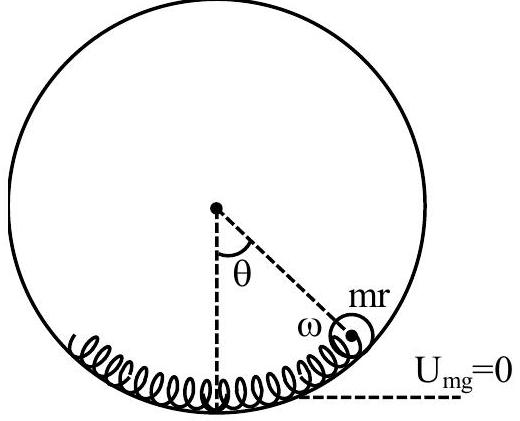
The disk undergoes rolling motion inside the ring. Using energy conservation:
E=21k(R−r)2θ2+mg(R−r)(1−cosθ)+21mv2+212mr2ω2
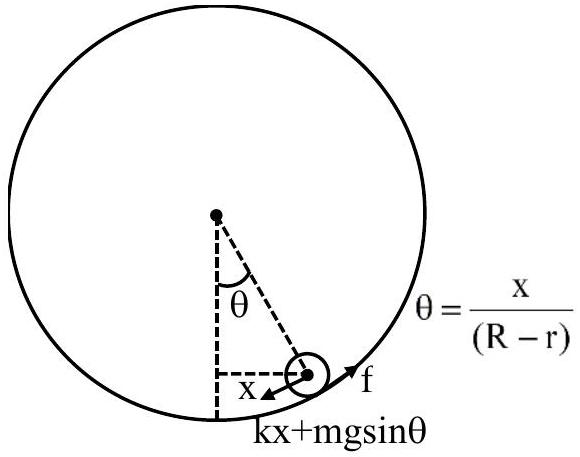
For small angles, cosθ≈1−2θ2. Differentiating with respect to time and using the rolling condition v=(R−r)dtdθ and ω=rv, we get:
−[k(R−r)+mg]θ=23m(R−r)dt2d2θ
Rearranging:
dt2d2θ=−32[mk+R−rg]θ
Comparing with the standard SHM equation dt2d2θ=−ω2θ:
ω=32[mk+R−rg]
JEE Advanced · 2025 · 18 May 2025 · Paper 1 · Single correct option