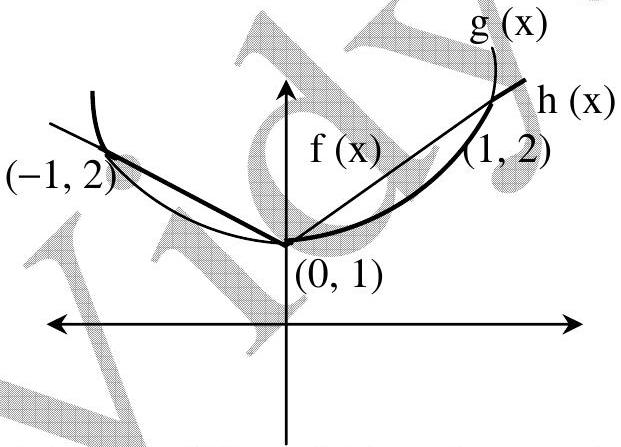
Let f:R→R and g:R→R be respectively given by f(x)=∣x∣+1 and g(x)=x2+1. Define h:R→R by
h(x)={max{f(x),g(x)}min{f(x),g(x)} if x≤0, if x>0.
The number of points at which h(x) is not differentiable is
Answer: 3
Solution
For x≤0: f(x)=−x+1 and g(x)=x2+1. We have f(x)=g(x) when −x+1=x2+1, giving x2+x=0, so x=0 or x=−1. For x<−1, f(x)>g(x); for −1<x<0, g(x)>f(x). So h(x)=f(x) for x≤−1 and h(x)=g(x) for −1≤x≤0. For x>0: f(x)=x+1 and g(x)=x2+1. We have f(x)=g(x) when x+1=x2+1, giving x=x2, so x=0 or x=1. For 0<x<1, f(x)<g(x); for x>1, g(x)<f(x). So h(x)=f(x) for 0<x≤1 and h(x)=g(x) for x≥1. The function h has potential non-differentiability at x=−1,0,1. At each of these points, the left and right derivatives differ, so h is not differentiable at 3 points.
JEE Advanced · 2014 · 25 May 2014 · Paper 1 · Integer answer