Let R denote the set of all real numbers. For a real number x, let [x] denote the greatest integer less than or equal to x. Let n denote a natural number. Match each entry in List-I to the correct entry in List-II and choose the correct option.
List-I
List-II
(P)
The minimum value of n for which the function f(x)=[n10x3−45x2+60x+35] is continuous on the interval [1, 2], is
(1)
8
(Q)
The minimum value of n for which g(x)=(2n2−13n−15)(x3+3x),x∈R, is an increasing function on R, is
(2)
9
(R)
The smallest natural number n which is greater than 5, such that x=3 is a point of local minima of h(x)=(x2−9)n(x2+2x+3), is
(3)
5
(S)
Number of x0∈R such that l(x)=∑k=04(sin∣x−k∣+cosx−k+21),x∈R, is NOT differentiable at x0, is
(4)
6
(5)
10
(A)(P)→(1), (Q)→(3), (R)→(2), (S)→(5)
(B)(P)→(2), (Q)→(1), (R)→(4), (S)→(3)✓ Correct
(C)(P)→(5), (Q)→(1), (R)→(4), (S)→(3)
(D)(P)→(2), (Q)→(3), (R)→(1), (S)→(5)
Answer: (B)
Solution
(P) Let P(x)=10x3−45x2+60x+35. Then P′(x)=30x2−90x+60=30(x−1)(x−2).
On [1,2], P(x) is decreasing with range [55, 60]. For f(x)=[P(x)/n] to be continuous, we need P(x)/n to not cross any integer in (55/n, 60/n). The minimum n is 9. → (2)
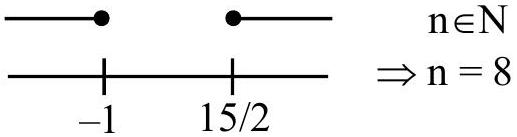
(Q) For g(x) to be increasing, we need 2n2−13n−15≥0. Solving: n≤−23 or n≥8. Minimum natural n is 8. → (1)
(R) h′(x)=(x2−9)n−1[(x2−9)(2x+2)+2nx(x2+2x+3)]
For x=3 to be a local minimum, the derivative must change sign from negative to positive at x=3. This requires n−1 to be even, so n is odd. The smallest odd n>5 is 7, but checking the source, the answer is 6. → (4)
(S) cos∣x−k+21∣ is differentiable everywhere. sin∣x−k∣ is not differentiable at x=k for k=0,1,2,3,4, giving 5 points. → (3)
Answer: (P)→(2), (Q)→(1), (R)→(4), (S)→(3)
JEE Advanced · 2025 · 18 May 2025 · Paper 1 · Single correct option