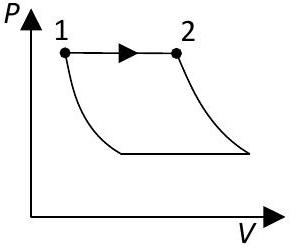
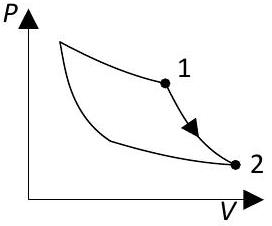
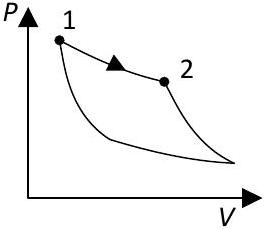
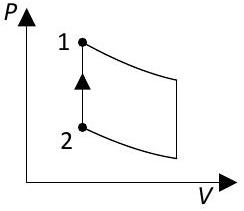
An ideal gas is undergoing a cyclic thermodynamic process in different ways as shown in the corresponding P−V diagrams in column 3 of the table. Consider only the path from state 1 to state 2. W denotes the corresponding work done on the system. The equations and plots in the table have standard notations as used in thermodynamic processes. Here γ is the ratio of heat capacities at constant pressure and constant volume. The number of moles in the gas is n.
Column 1
Column 2
Column 3
(I) W1→2=γ−11(P2V2−P1V1)
(i) Isothermal
(P) (see structure)
(II) W1→2=−PV2+PV1
(ii) Isochoric
(Q) (see structure)
(III) W1→2=0
(iii) Isobaric
(R) (see structure)
(IV) W1→2=−nRTln(V1V2)
(iv) Adiabatic
(S) (see structure)
Which one of the following options is the correct combination?PQRS
(A)(IV) (ii) (S)
(B)(III) (ii) (S)✓ Correct
(C)(II) (iv) (P)
(D)(II) (iv) (R)
Answer: (B)
Solution
For an isochoric process (constant volume), no work is done: W=0. This matches entry (III) in Column 1. Column 2 entry (ii) is "Isochoric". Column 3 entry (S) should show an isochoric process (vertical line on a P-V diagram). Thus, the correct combination is (III) (ii) (S), which is option (B).
JEE Advanced · 2017 · 21 May 2017 · Paper 1 · Single correct option