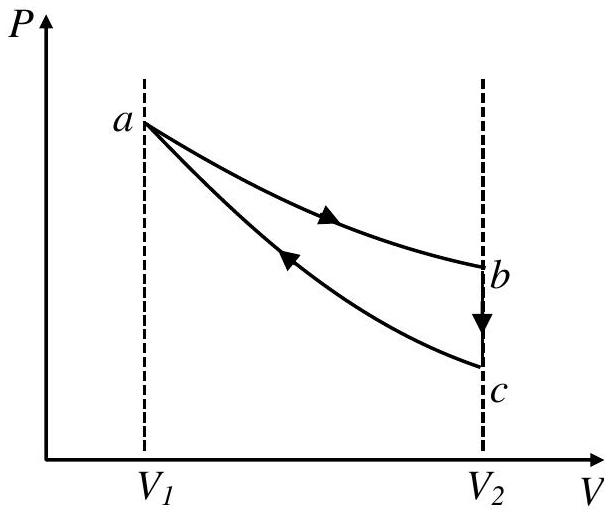
A quasi-static cycle of a monoatomic ideal gas contains an isothermal process (ab), followed by an isochoric process (bc) and an adiabatic process (ca) as shown in the figure. The volumes of the gas are V1 and V2 at a and b, respectively. If the cycle has heat input Qin and output Qout , then the efficiency of the cycle is defined as η=Qin Qin −Qout . The correct statement(s) is/are: [Given :ln2≈0.7 ]
(A)If V2/V1=8, the heat released in the process bc is smaller than the heat absorbed in the process ab.✓ Correct
(B)For a given value of V2/V1,η does not depend on the temperature of the isothermal process✓ Correct
(C)If V2/V1=8, then the temperature of the gas at a is 4 times the temperature of the gas at c.✓ Correct
(D)If V2/V1=8, then the pressure of the gas at a is 4 times the pressure of the gas at b.
Answer: (A), (B), (C)
Solution
For monoatomic gas: Cv=23R, γ=35.
(A) For a clockwise P-V cycle: Qab+Qbc+Qca>0. Since Qca=0 (adiabatic), Qab>−Qbc, meaning heat absorbed in ab exceeds heat released in bc ✓
(B)η=1−RCv⋅(ln(V2/V1)1−Tc/Ta). Using adiabatic relation TaV1γ−1=TcV2γ−1, the ratio Tc/Ta depends only on V2/V1, making η independent of Ta ✓
(C)TcTa=(V1V2)γ−1=82/3=4 ✓
(D) For isothermal process ab: PbPa=V1V2=8=4 ✗
JEE Advanced · 2026 · 17 May 2026 · Paper 1 · One or more correct options