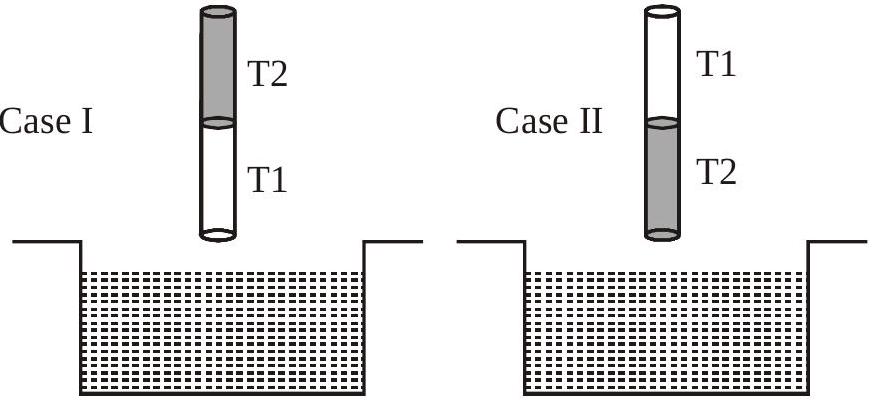
A cylindrical capillary tube of 0.2 mm radius is made by joining two capillaries T1 and T2 of different materials having water contact angles of 0° and 60°, respectively. The capillary tube is dipped vertically in water in two different configurations, case I and II as shown in figure. Which of the following option(s) is(are) correct ? (Surface tension of water =0.075N/m, density of water =1000kg/m3, take g=10m/s2)
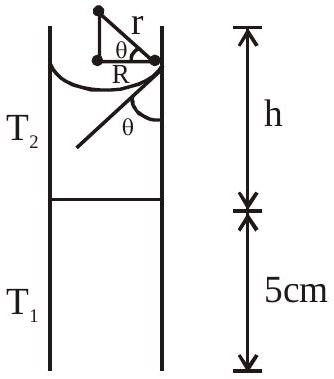
(A)The correction in the height of water column raised in the tube, due to weight of water contained in the meniscus, will be different for both cases.✓ Correct
(B)For case I, if the capillary joint is 5 cm above the water surface, the height of water column raised in the tube will be more than 8.75 cm. (Neglect the weight of the water in the meniscus)
(C)For case I, if the joint is kept at 8 cm above the water surface, the height of water column in the tube will be 7.5 cm. (Neglect the weight of the water in the meniscus)✓ Correct
(D)For case II, if the capillary joint is 5 cm above the water surface, the height of water column raised in the tube will be 3.75 cm. (Neglect the weight of the water in the meniscus)✓ Correct
Answer: (A), (C), (D)
Solution
Capillary rise formula: h=ρgR2Tcosθ
For T1 (θ=0°):
h1=1000×10×0.2×10−32×0.075×1=75 mm=7.5 cm
For T2 (θ=60°):
h2=1000×10×0.2×10−32×0.075×0.5=37.5 mm=3.75 cm
(A) Since contact angles are different, meniscus corrections will be different. Correct.
(B) If joint is 5 cm above water in Case I, water would need to rise 5 cm in T1 then continue in T2. But T2 only supports 3.75 cm rise, so water won't cross the interface. Incorrect.
(C) If interface is 8 cm above water, water will only rise 7.5 cm in T1 and stop. Correct.
(D) In Case II, T2 is at bottom. Water rises only 3.75 cm in T2 and stops. Correct.
JEE Advanced · 2019 · 27 May 2019 · Paper 1 · One or more correct options