List I describes four systems, each with two particles A and B in relative motion as shown in figure. List II gives possible magnitudes of their relative velocities (in ms−1) at time t=3πs.
List-I
List-II
(I)
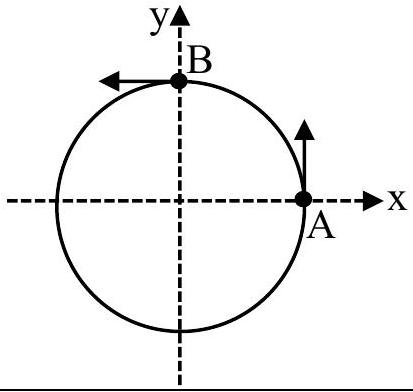
A and B are moving on a horizontal circle of radius 1m with uniform angular speed ω=1rads−1. The initial angular positions of A and B at time t=0 are θ=0 and θ=2π respectively.
(P)
23+1
(II)
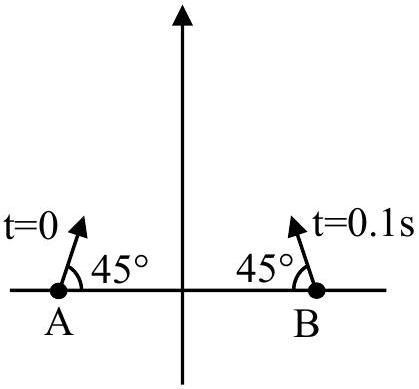
Projectiles A and B are fired (in the same vertical plane) at t=0 and t=0.1s respectively, with the same speed v=25πms−1 and at 45° from the horizontal plane. The initial separation between A and B is large enough so that they do not collide. (g=10ms−2).
(Q)
2(3−1)
(III)
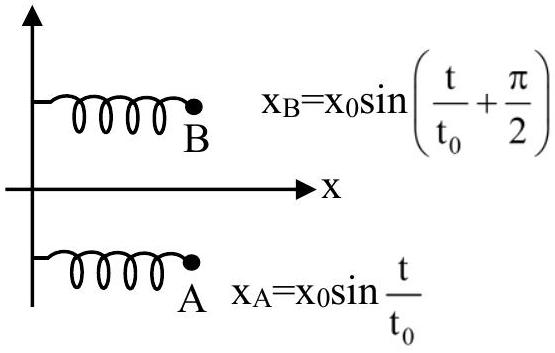
Two harmonic oscillators A and B moving in the x direction according to xA=x0sint0t and xB=x0sin(t0t+2π) respectively, starting from t=0. Take x0=1m,t0=1s.
(R)
10
(IV)
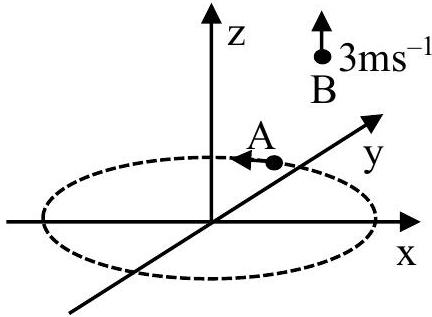
Particle A is rotating in a horizontal circular path of radius 1m on the xy plane, with constant angular speed ω=1rads−1. Particle B is moving up at a constant speed 3ms−1 in the vertical direction as shown in the figure. (Ignore gravity.)
(S)
2
(T)
25π2+1
Which one of the following options is correct?IIIIIIIV
(A)I→R, II→T, III→P, IV→S
(B)I→S, II→P, III→Q, IV→R
(C)I→S, II→T, III→P, IV→R✓ Correct
(D)I→T, II→P, III→R, IV→S
Answer: (C)
Solution
(I) Both particles move with v=ωr=1 m/s, maintaining 90° separation. Relative velocity:
vBA=vA2+vB2=2
m/s I→S
(II) At t=π/3 s:
A: vA=25πi^−65πj^
B (launched 0.1 s later, at t=π/3−0.1): vB=−25πi^−(65π+1)j^
vBA=−5πi^−j^
∣vBA∣=25π2+1
II→T
(III) At t=π/3:
vA=cos(π/3)=1/2 m/s
vB=−sin(π/3)=−3/2 m/s
vBA=−3/2−1/2=2−(3+1)
Magnitude: 23+1 III→P
(IV)vA (tangential, magnitude 1) and vB (vertical, magnitude 3) are perpendicular:
∣vBA∣=12+32=10
IV→R
Answer: (C) I→S, II→T, III→P, IV→R
JEE Advanced · 2022 · 28 Aug 2022 · Paper 1 · Single correct option