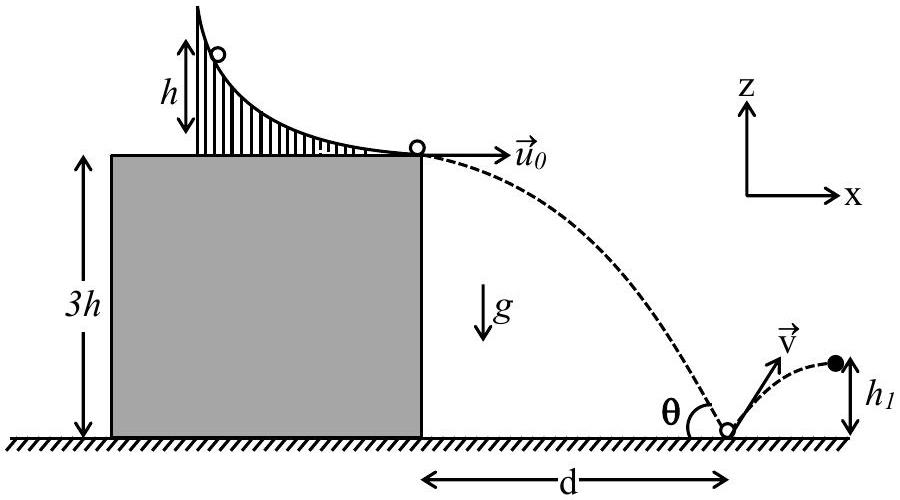
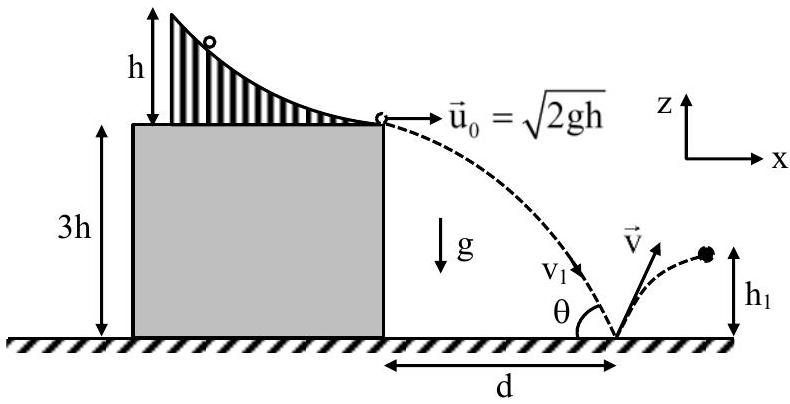
A slide with a frictionless curved surface, which becomes horizontal at its lower end, is fixed on the terrace of a building of height 3h from the ground, as shown in the figure. A spherical ball of mass m is released on the slide from rest at a height h from the top of the terrace. The ball leaves the slide with a velocity u0=u0x^ and falls on the ground at a distance d from the building making an angle θ with the horizontal. It bounces off with a velocity v and reaches a maximum height h1. The acceleration due to gravity is g and the coefficient of restitution of the ground is 1/3. Which of the following statement(s) is(are) correct?
(A)u0=2ghx^✓ Correct
(B)v=2gh(x^−z^)
(C)θ=60∘✓ Correct
(D)d/h1=23✓ Correct
Answer: (A), (C), (D)
Solution
The ball starts from rest at height h above the terrace and slides down frictionlessly. By energy conservation, when it leaves the slide horizontally: mgh=21mu02, giving u0=2gh, so option (A) is correct.
The ball then falls from height 3h with initial horizontal velocity u0=2gh. Just before hitting the ground, the vertical component is vy=2g(3h)=6gh downward, while horizontal component remains vx=2gh.
After bouncing with coefficient of restitution e=1/3, the vertical component becomes vy′=e⋅6gh=31⋅6gh=2gh upward, while horizontal component is unchanged. Thus v=2ghx^+2ghz^ (taking z^ upward). Option (B) has a minus sign, so it's incorrect.
The angle with horizontal: tanθ=2gh6gh=3, giving θ=60°. Option (C) is correct.
Maximum height after bounce: h1=2g(vy′)2=2g2gh=h.
Horizontal distance: d=vx⋅t where t=g2(3h) is the fall time. Thus d=2gh⋅g6h=23h.
Therefore d/h1=23h/h=23. Option (D) is correct.
JEE Advanced · 2023 · 04 Jun 2023 · Paper 1 · One or more correct options