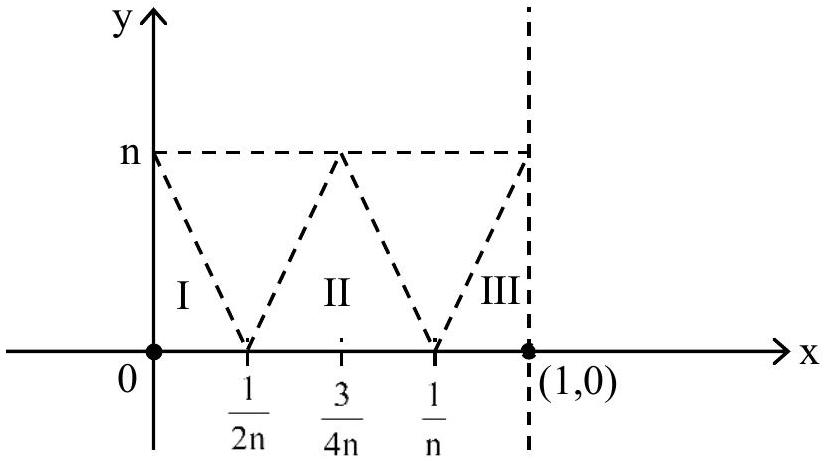
Let n≥2 be a natural number and f:[0,1]→R be the function defined by
f(x)=⎩⎨⎧n(1−2nx)2n(2nx−1)4n(1−nx)n−1n(nx−1) if 0≤x≤2n1 if 2n1≤x≤4n3 if 4n3≤x≤n1 if n1≤x≤1
If n is such that the area of the region bounded by the curves x=0,x=1,y=0 and y=f(x) is 4, then the maximum value of the function f is
Answer: 8
Solution
Each piece of f is a straight segment, so the region under the graph splits into triangles. The first piece rises from 0 to n over width 2n1 (area 41); the second and third pieces form two triangles each of base 4n1 and height n (area 81 each); and the last piece is a triangle of base nn−1 and height n (area 2n−1). The total area is 41+81+81+2n−1=2n. Setting this equal to 4 gives n=8. Since the graph attains its greatest value n at the peaks, the maximum value of f is 8.
JEE Advanced · 2023 · 04 Jun 2023 · Paper 1 · Integer answer