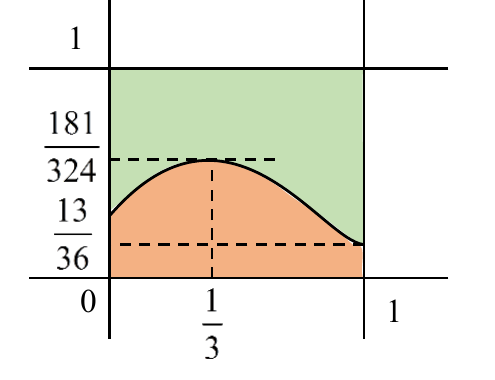
Let f:[0,1]→[0,1] be the function defined by f(x)=3x3−x2+95x+3617. Consider the square region S=[0,1]×[0,1]. Let G={(x,y)∈S:y>f(x)} be called the green region and R={(x,y)∈S:y<f(x)} be called the red region. Let Lh={(x,h)∈S:x∈[0,1]} be the horizontal line drawn at a height h∈[0,1]. Then which of the following statements is(are) ture?
(A)There exists an h∈[41,32] such that the area of the green region above the line Lh equals the area of the green region below the line Lh
(B)There exists an h∈[41,32] such that the area of the red region above the line Lh equals the area of the red region below the line Lh✓ Correct
(C)There exists an h∈[41,32] such that the area of the green region above the line Lh equals the area of the red region below the line Lh✓ Correct
(D)There exists an h∈[41,32] such that the area of the red region above the line Lh equals the area of the green region below the line Lh✓ Correct
Answer: (B), (C), (D)
Solution
f′(x)=x2−2x+95 has a critical point at x=31 in [0,1].
f(0)=3617, f(1)=3613≈0.36, f(31)=324181≈0.558
The area of red region AR=∫01f(x)dx=21, and area of green region AG=1−21=21.
(A) For equal green areas above and below Lh, we need h=43, which is outside [41,32]. (A) is incorrect.
(B) For equal red areas above and below Lh, we need h=41∈[41,32]. (B) is correct.
(C) By intermediate value theorem, there exists h∈(3613,324181)⊂[41,32] where green area above equals red area below. (C) is correct.
(D) This is the complementary coloring of (C), so it is also correct. (D) is correct.
Answer: (B), (C), (D)
JEE Advanced · 2023 · 04 Jun 2023 · Paper 1 · One or more correct options