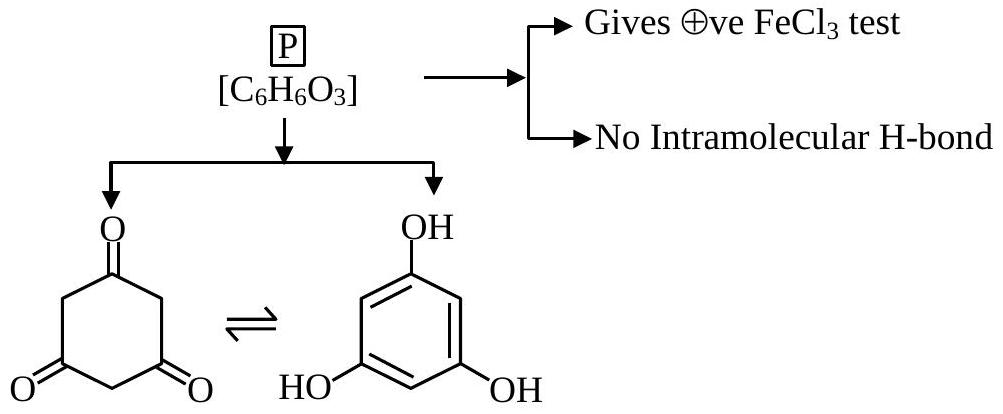
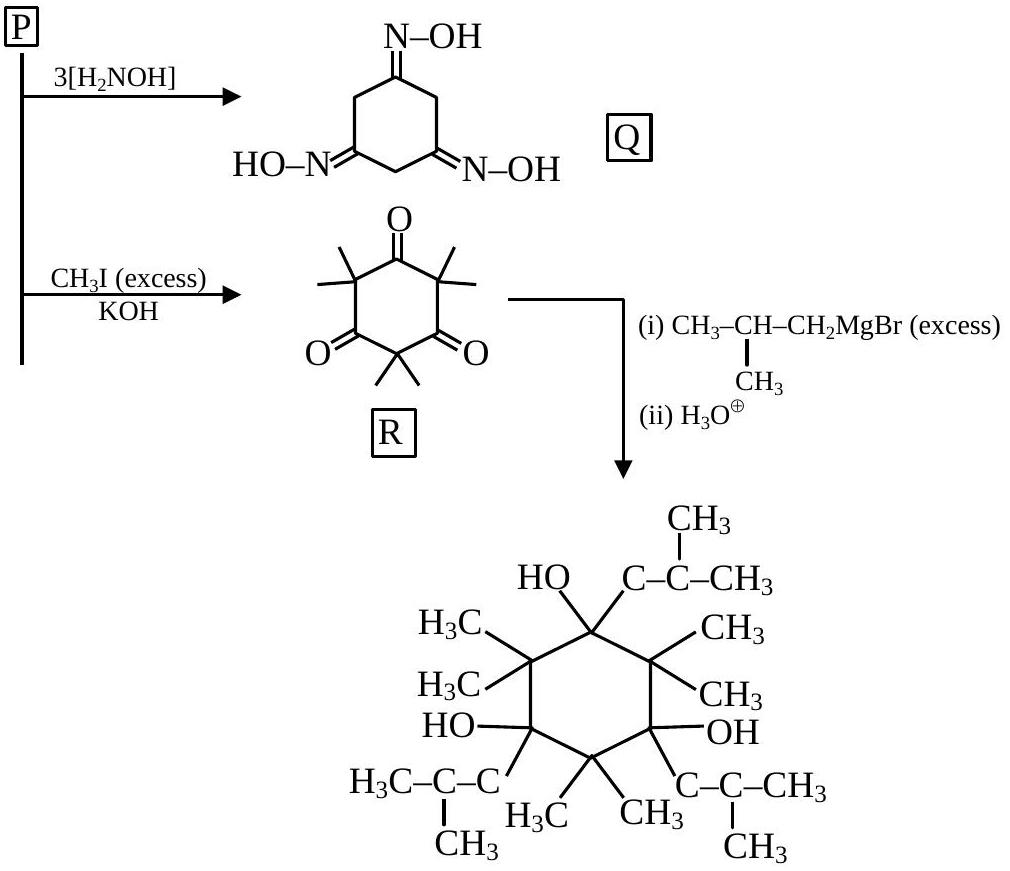
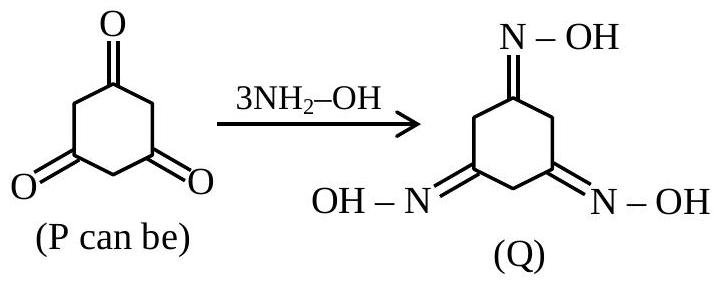
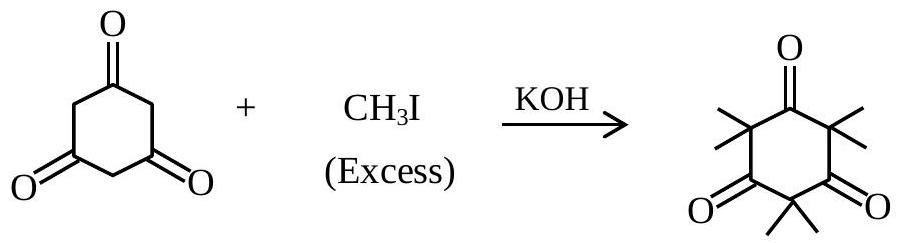
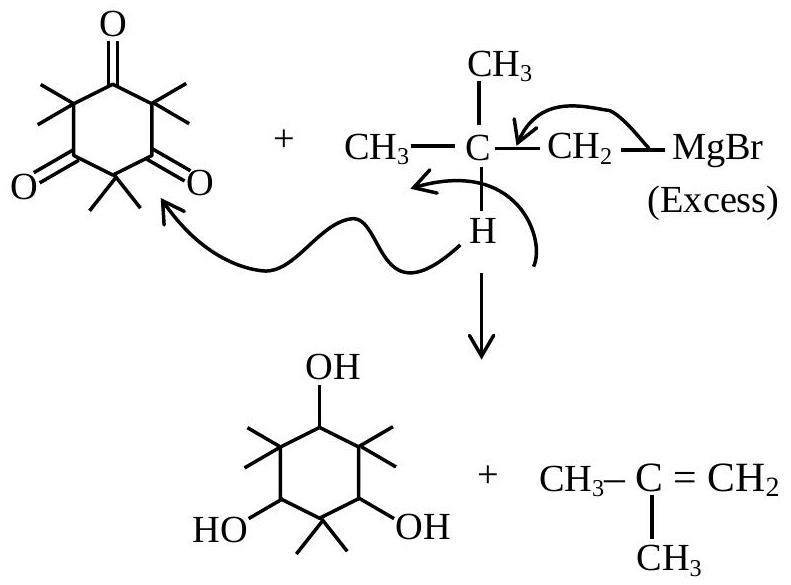
An organic compound P having molecular formula C6H6O3 gives ferric chloride test and does not have intramolecular hydrogen bond. The compound P reacts with 3 equivalents of NH2OH to produce oxime Q. Treatment of P with excess methyl iodide in the presence of KOH produces compound R as the major product. Reaction of R with excess iso-butylmagnesium bromide followed by treatment with H3O+ gives compound S as the major product. The total number of methyl ( −CH3 ) group(s) in compound S is ____.
Answer: 6
Solution
Compound P is phloroglucinol (1,3,5-trihydroxybenzene). It gives a positive ferric chloride test (phenolic OH) and has no intramolecular H-bonding due to symmetry.
P reacts with 3 equivalents of NH2OH, indicating it has 3 carbonyl groups in its keto form (1,3,5-triketocyclohexane tautomer).
Treatment with excess CH3I/KOH methylates all three OH groups to give R (1,3,5-trimethoxybenzene).
Reaction with excess iso-butyl Grignard reagent converts the three methoxy groups. Each methoxy can be attacked, and after hydrolysis, tertiary alcohols are formed with iso-butyl groups attached.
Each iso-butyl group contains 2 methyl groups, and there are 3 such groups, giving 6 methyls from iso-butyl. Additionally, the 3 original methoxy groups contribute 3 methyls. However, the major product S after complete reaction has 3 tertiary alcohol centers, each bearing 2 iso-butyl groups (each with 2 methyls), giving a total of 3 × 2 × 2 = 12 methyl groups.
The answer is 12.
JEE Advanced · 2024 · 26 May 2024 · Paper 2 · Integer answer