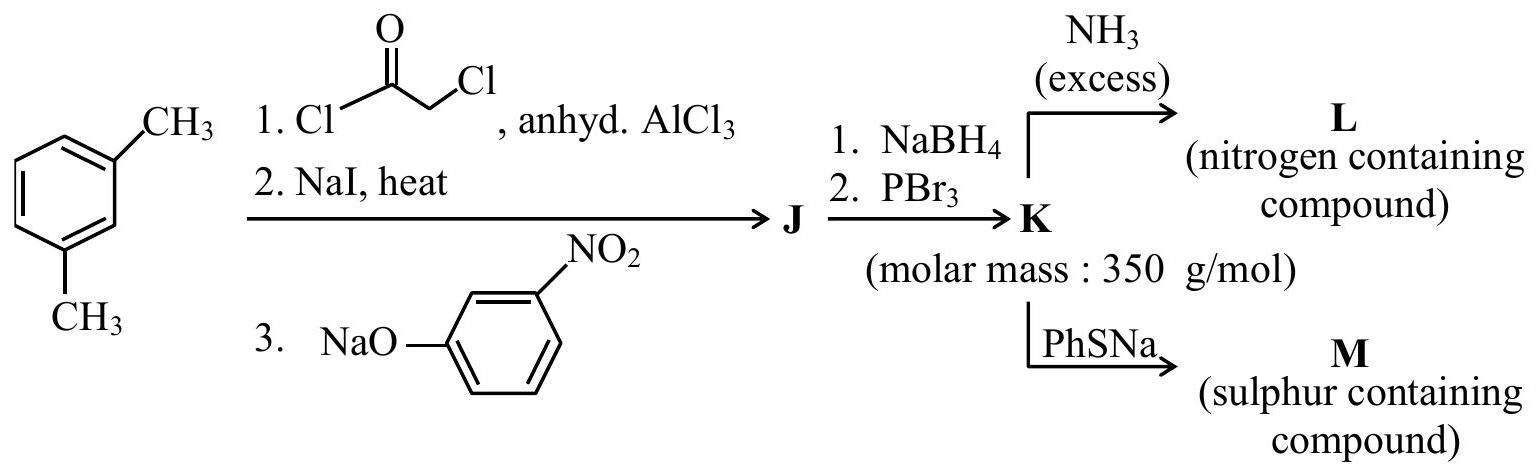
Consider the following reaction sequence in which J, K, L and M are the major products.
Given: Atomic mass (in amu): H : 1, C : 12, N : 14, O : 16, S : 32, Br : 80, Ba : 137
The volume of 1 M aqueous H2SO4 required to completely neutralize the ammonia evolved from 5.72 g of L in Kjeldahl's method of nitrogen estimation is ____ mL.
Answer: 10
Solution
Follow the sequence to L.
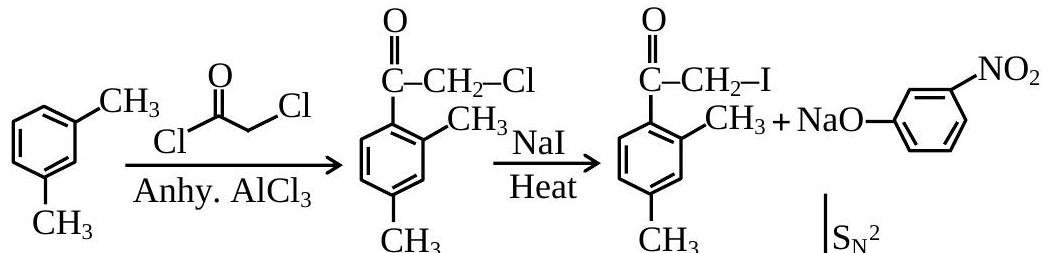
p-Xylene + ClCH2COCl / anhyd. AlCl3 (Friedel–Crafts acylation) gives the chloromethyl ketone Ar−CO−CH2Cl (Ar = 2,5-dimethylphenyl).
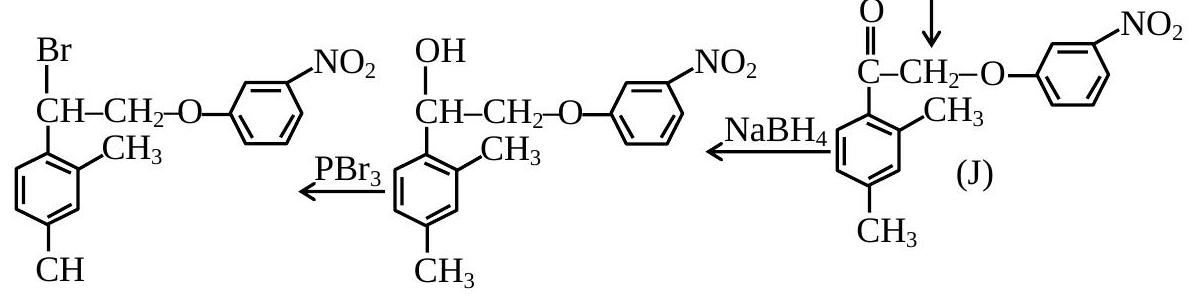
NaI, heat (Finkelstein) converts it to Ar−CO−CH2I; the 3-nitrophenoxide then displaces iodide (SN2) to give J=Ar−CO−CH2−O−C6H4NO2.
NaBH4 reduces the ketone to the secondary alcohol and PBr3 converts that to the bromide K=Ar−CH(Br)−CH2−O−C6H4NO2, molar mass 350 g mol−1 (given).
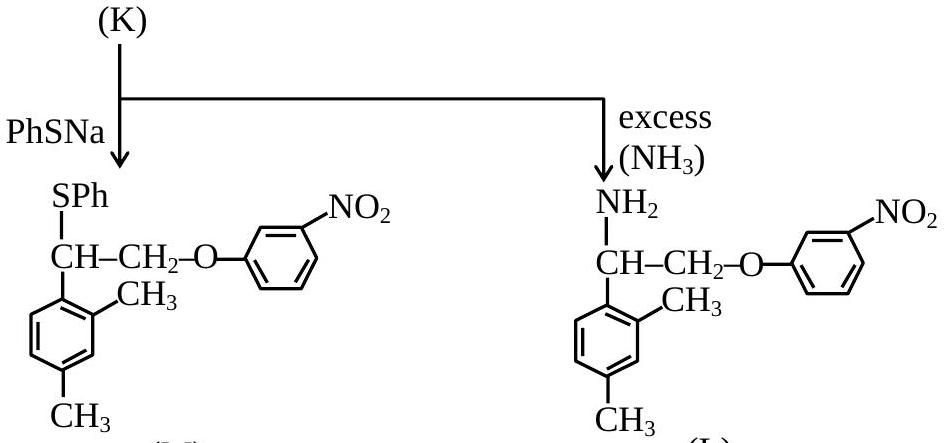
Excess NH3 replaces Br by NH2: L=Ar−CH(NH2)−CH2−O−C6H4NO2. Its molar mass is 350−80(Br)+16(NH2)=286 g mol−1. (M, from PhSNa, is the sulphur analogue.)
Kjeldahl's method converts only amino/amide nitrogen to NH3; the nitrogen of a nitro group is *not* estimated. So each mole of L gives one mole of NH3 (from the NH2 group).
Moles of L =2865.72=0.02 mol ⇒ moles of NH3=0.02 mol.
2NH3+H2SO4→(NH4)2SO4⇒moles of H2SO4=20.02=0.01 mol
Volume of 1 M H2SO4=10.01×1000=10 mL.
Answer: 10.00
JEE Advanced · 2026 · 17 May 2026 · Paper 2 · Numerical answer