JEE Main · 2026 · 06 Apr 2026 · Shift 2 · Redox Reactions and Electrochemistry

WhatsApp Email
For a general redox reaction

Anode
Cathode
Which of the following statement is incorrect?
  1. (A)The overall reaction can be written as
  2. (B)The electrons do not appear in the overall reaction because electrons produced at the anode are consumed at the cathode.
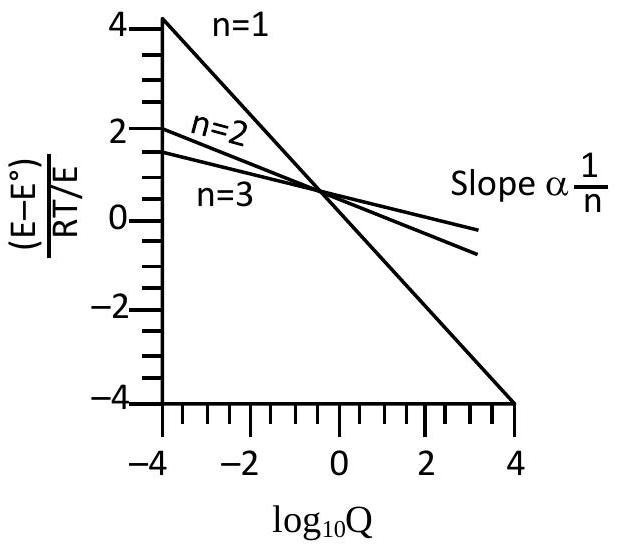
  3. (C)(see structure)
  4. (D)If the reaction is carried out reversibly, the electrical work done is equal to the ratio of charge and potential difference through which charge is moved.✓ Correct

Answer: (D)

Solution

Balancing the electrons lost and gained gives the overall reaction , and because the electrons released at the anode are consumed at the cathode they do not appear in the overall equation; the Nernst plot of against is a straight line whose slope varies as . The reversible electrical work is the product of the charge moved and the potential difference, , so the statement equating this work with the ratio of charge to potential difference is the wrong one.

JEE Main · 2026 · 06 Apr 2026 · Shift 2 · Single correct option

More JEE Main questions on Redox Reactions and Electrochemistry

  1. The pH and conductance of a weak acid (HX) was found to be 5 and , respectively. The conductance was measured under standard condition using a cell where the electrode plates having a surface area of were at a distance of 15 cm a …
    JEE Main 2026View solution →
  2. Consider the following electrochemical cell at 298 K
    .
    If the reaction quotient at a giv …
    JEE Main 2026View solution →
  3. Aqueous HCl reacts with to form , and . What is the weight (in g) of liberated when 8.7 g of is reacted w …
    JEE Main 2026View solution →
  4. For a closed circuit Daniell cell, which of the following plots is the accurate one at a given temperature?
    JEE Main 2026View solution →
  5. MX is a sparingly soluble salt that follows the given solubility equilibrium at 298 K
    ;
    If the standard reduction potential for …
    JEE Main 2026View solution →
  6. Consider the following reduction processes:

    …
    JEE Main 2026View solution →