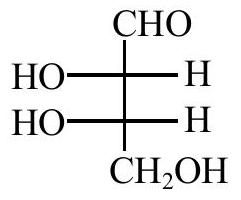
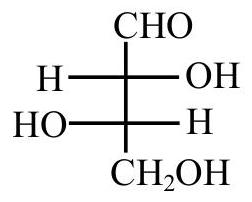
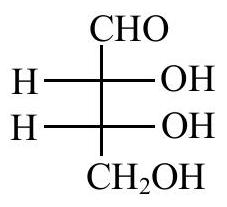
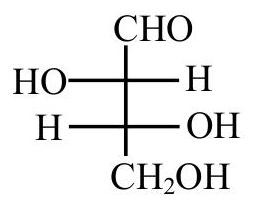
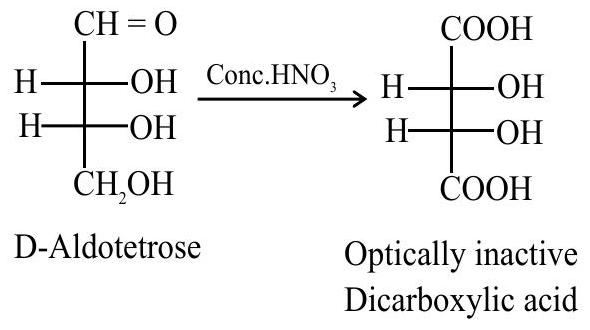
A D-aldotetrose on oxidation with concentrated HNO3 resulted in optically inactive dicarboxylic acid. The structure of the D-aldotetrose is:
(A)(see structure)
(B)(see structure)
(C)(see structure)✓ Correct
(D)(see structure)
Answer: (C)
Solution
A D-aldotetrose is OHC−CHOH−CHOH−CH2OH with the lowest stereocentre (C-3) hydroxyl on the right in the Fischer projection. Concentrated HNO3 oxidises both the aldehyde and the terminal CH2OH to COOH, giving a 2,3-dihydroxybutanedioic (tartaric) acid. This diacid is optically inactive only as its meso form, which needs the two hydroxyls on the same side of the projection. The aldotetrose having both the C-2 and C-3 hydroxyls on the right (D-erythrose) oxidises to meso-tartaric acid, whose internal mirror plane makes it optically inactive, whereas the isomer with the hydroxyls on opposite sides (D-threose) gives an optically active acid. The required D-aldotetrose is D-erythrose, the structure with both hydroxyl groups on the right.
JEE Main · 2026 · 04 Apr 2026 · Shift 2 · Single correct option