JEE Main · 2013 · 07 Apr 2013 · Offline · Haloalkanes and Haloarenes

WhatsApp Email
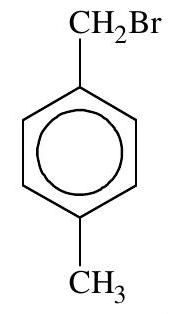
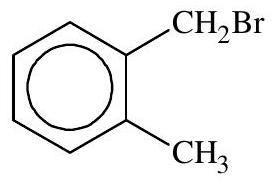
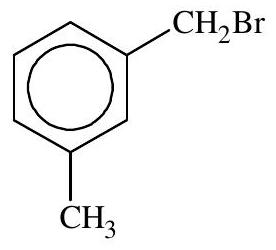
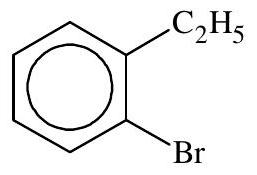
Compound (A), , gives a white precipitate when warmed with alcoholic . Oxidation of (A) gives a acid (B), . (B) easily forms anhydride on heating. Identify the compound (A).
  1. (A)(see structure)
  2. (B)(see structure)
  3. (C)(see structure)
    ✓ Correct
  4. (D)(see structure)

Answer: (C)

Solution

Three clues pin down the structure. The white precipitate with alcoholic marks a reactive benzylic bromide rather than an unreactive aryl bromide. Oxidation to , a benzene dicarboxylic acid, and the ease with which that acid loses water to an anhydride, point to the two acid groups sitting ortho to one another, as in phthalic acid. Working back, compound A is the ortho isomer, -methylbenzyl bromide, whose benzylic and ring methyl both oxidise to give phthalic acid.

JEE Main · 2013 · 07 Apr 2013 · Offline · Single correct option
More JEE Main questions on Haloalkanes and Haloarenes

  1. The correct order of reactivity of in methanol with the following nucleophiles is and
    JEE Main 2026View solution →
  2. The correct order of the rate of reaction of the following reactants with nucleophile by mechanism is :
    (Given : Structure I and II are rigid)
    JEE Main 2026View solution →
  3. The correct order of reactivity of the following benzyl halides towards reaction with KCN is:
    JEE Main 2026View solution →
  4. The correct order of the rate of the reaction for the following reaction with respect to nucleophiles is:
    JEE Main 2026View solution →
  5. Given below are four compounds:
    (a) n-propyl chloride
    (b) iso-propyl chloride
    (c) sec-butyl chloride
    (d) neo-pentyl chloride

    Percentage of carbon in the one which exhibits optical isomerism is:
    JEE Main 2026View solution →
  6. Consider the following reaction :


    The product Y formed is :
    JEE Main 2026View solution →