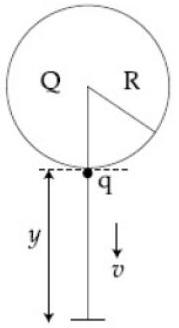
A solid sphere of radius R carries a charge Q+q distributed uniformly over its volume. A very small point like piece of it of mass m gets detached from the bottom of the sphere and falls down vertically under gravity. This piece carries charge q. If it acquires a speed u when it has fallen through a vertical height h (see figure), then: (assume the remaining portion to be spherical)
(A)v2=y[4πϵ0R2ymqQ+g]
(B)v2=2y[4πϵ0R(R+y)mqQ+g]✓ Correct
(C)v2=y[4πϵ0R(R+y)mqQ+g]
(D)v2=2y[4πϵ0(R+y)3mQqR+g]
Answer: (B)
Solution
A small piece carrying charge q breaks off the bottom of the sphere, which sits a distance R from the centre, and falls to a distance R+y from the centre. Two forces do work on it as it falls: gravity, and the Coulomb repulsion from the remaining charge Q, which may be treated as concentrated at the centre. The gravitational work over the drop is mgy, while the electrostatic work is ∫RR+y4πϵ0x2Qqdx=4πϵ0Qq(R1−R+y1)=4πϵ0R(R+y)Qqy. By the work-energy theorem these together equal the kinetic energy gained, 21mv2, so 21mv2=mgy+4πϵ0R(R+y)Qqy. Solving for the speed gives v2=2y[4πϵ0R(R+y)mqQ+g].
JEE Main · 2020 · 05 Sep 2020 · Shift 1 · Single correct option