JEE Main · 2020 · 03 Sep 2020 · Shift 1 · Haloalkanes and Haloarenes

WhatsApp Email
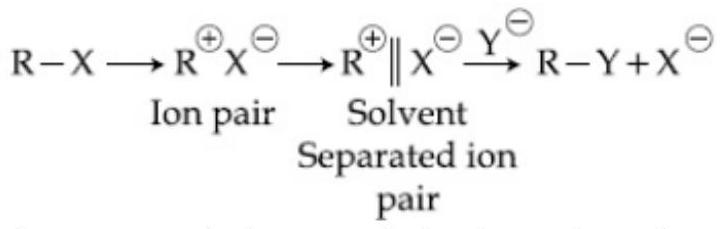
The mechanism of reaction is given as:

A student writes general characteristics based on the given mechanism as:
(a) The reaction is favoured by weak nucleophiles.
(b) would be easily formed if the substituents are bulky.
(c) The reaction is accompanied by racemization.
(d) The reaction is favoured by non-polar solvents.

Which observations are correct?
  1. (A)(b) and (d)
  2. (B)(a), (b) and (c)✓ Correct
  3. (C)(a) and (c)
  4. (D)(a) and (b)

Answer: (B)

Solution

An reaction goes through a carbocation formed in the slow step, with the nucleophile entering only afterwards. Because that rate-determining step does not involve the nucleophile, even weak nucleophiles serve, so (a) holds; bulkier groups relieve their crowding and stabilise the cation as it forms, making easier to produce, so (b) holds; and the flat carbocation is attacked from either face, giving both configurations and hence racemisation, so (c) holds. Only the claim about non-polar solvents is wrong, since is in fact favoured by polar solvents that stabilise the ionic intermediate. The correct observations are (a), (b) and (c).

JEE Main · 2020 · 03 Sep 2020 · Shift 1 · Single correct option
More JEE Main questions on Haloalkanes and Haloarenes

  1. The correct order of reactivity of in methanol with the following nucleophiles is and
    JEE Main 2026View solution →
  2. The correct order of the rate of reaction of the following reactants with nucleophile by mechanism is :
    (Given : Structure I and II are rigid)
    JEE Main 2026View solution →
  3. The correct order of reactivity of the following benzyl halides towards reaction with KCN is:
    JEE Main 2026View solution →
  4. The correct order of the rate of the reaction for the following reaction with respect to nucleophiles is:
    JEE Main 2026View solution →
  5. Given below are four compounds:
    (a) n-propyl chloride
    (b) iso-propyl chloride
    (c) sec-butyl chloride
    (d) neo-pentyl chloride

    Percentage of carbon in the one which exhibits optical isomerism is:
    JEE Main 2026View solution →
  6. Consider the following reaction :


    The product Y formed is :
    JEE Main 2026View solution →