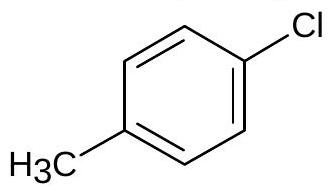
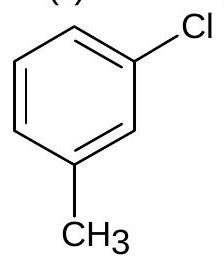
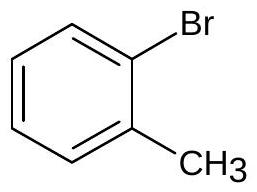
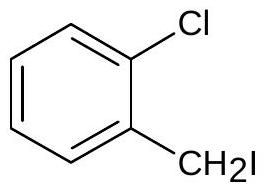
Among the following compounds I-IV, which one forms a yellow precipitate on reacting sequentially with (i) NaOH (ii) dil. HNO3 (iii) AgNO3 ?IIIIIIIV
(A)II
(B)IV✓ Correct
(C)III
(D)I
Answer: (B)
Solution
The yellow precipitate obtained with silver nitrate is silver iodide, so the compound must give up iodide ion to the alkali in the first step. In an aryl halide the carbon-halogen bond has partial double bond character from conjugation of the halogen lone pair with the ring, and the ring carbon is also inaccessible to attack from behind, so chlorotoluenes and bromotoluene are not hydrolysed by aqueous sodium hydroxide and release no halide ion. Compound IV, 2-chlorobenzyl iodide, carries the iodine on a benzylic carbon, where the transition state for substitution is stabilised by the ring, so sodium hydroxide displaces iodide easily while the aryl chlorine stays put. Acidifying with dilute nitric acid and adding silver nitrate then precipitates yellow AgI, so the compound that responds is 2-chlorobenzyl iodide.
JEE Main · 2021 · 26 Aug 2021 · Shift 1 · Single correct option