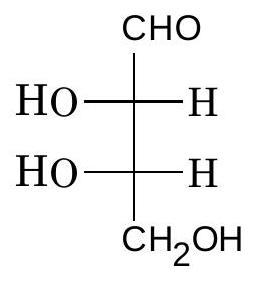
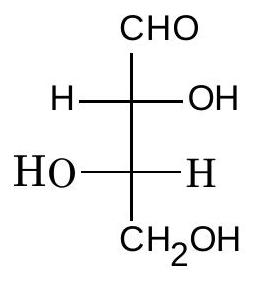
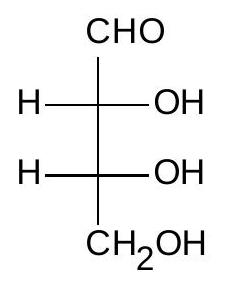
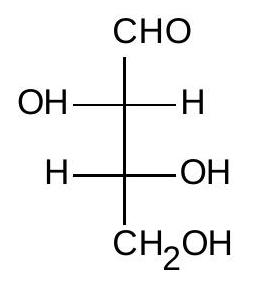
L-isomer of a compound 'A' (C4H8O4) gives a positive test with [Ag(NH3)2]+. Treatment of 'A' with acetic anhydride yield triacetate derivative. Compound 'A' produces an optically active compound (B) and an optically inactive compound (C) on treatment with bromine water and HNO3 respectively, compound (A) is:
(A)(see structure)✓ Correct
(B)(see structure)
(C)(see structure)
(D)(see structure)
Answer: (A)
Solution
Compound A (C₄H₈O₄) gives a positive Tollens' test, indicating an aldehyde group. It forms a triacetate, meaning it has three -OH groups. The molecular formula and functional groups suggest it is an aldotetrose (a four-carbon sugar with an aldehyde). Since it's the L-isomer and produces an optically active compound with Br₂/H₂O (oxidation to aldonic acid) and an optically inactive compound with HNO₃ (oxidation to aldaric acid), compound A must be L-threose. L-threose has the aldehyde at C1 and three hydroxyl groups that can be acetylated. Oxidation with HNO₃ gives tartaric acid (meso form, optically inactive), while Br₂/H₂O gives threonic acid (optically active). Option (A) represents the correct structure.
JEE Main · 2022 · 27 Jun 2022 · Shift 1 · Single correct option