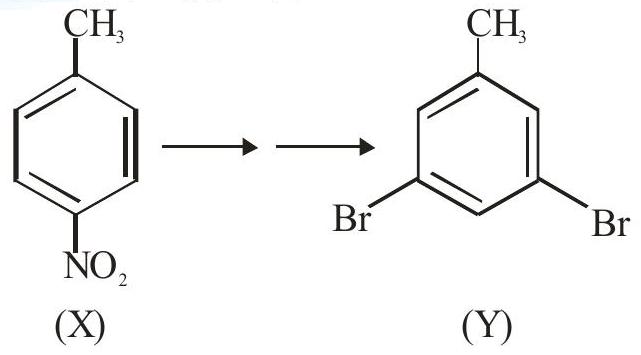
In the above conversion of compound ( X ) to product (Y), the sequence of reagents to be used will be:
(A)(i) Br2,Fe (ii) Fe,H+ (iii) LiAlH4
(B)(i) Br2(aq) (ii) LiAlH4 (iii) H3O+
(C)(i) Fe,H+ (ii) Br2(aq) (iii) HNO2 (iv) CuBr
(D)(i) Fe,H+ (ii) Br2(aq) (iii) HNO2 (iv) H3PO2✓ Correct
Answer: (D)
Solution
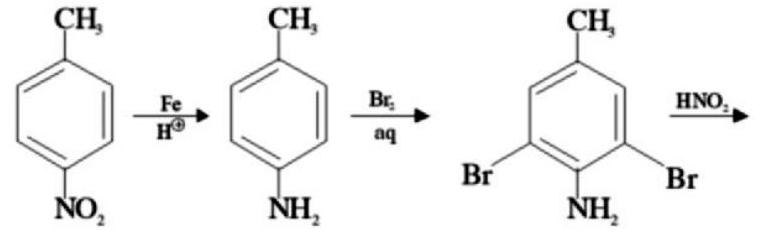
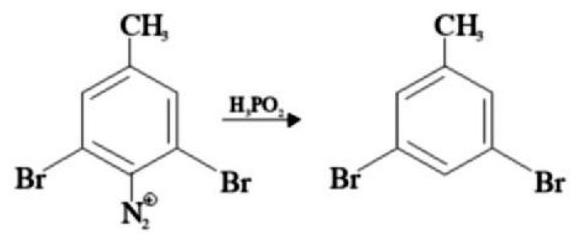
The product carries its two bromines meta to the methyl group, a pattern that direct bromination of the methyl ring cannot give, since methyl directs ortho and para. The route works through nitrogen instead. The nitro group is first reduced to an amino group with iron and acid to give para-toluidine. The strongly activating amino group now directs bromination, and bromine water installs bromine at both positions ortho to nitrogen, which are the positions meta to the methyl group. The amino group, having done its work, is converted to the diazonium salt with nitrous acid and then replaced by hydrogen with hypophosphorous acid. What is left is the methyl ring bearing two bromines meta to the methyl group, reached by the sequence iron and acid, then bromine water, then nitrous acid, then hypophosphorous acid.
JEE Main · 2023 · 30 Jan 2023 · Shift 2 · Single correct option