Nucleophilic substitution of a haloalkane can proceed by either the SN1 or the SN2 mechanism. SN1 is a two-step reaction while SN2 is a single-step reaction; which mechanism a haloalkane follows depends on the structure of the haloalkane, the leaving group, the nucleophile and the solvent. In an SN1 reaction the polarity of the system increases from reactant to transition state, so a polar solvent stabilises the transition state more than the reactant, lowers the activation energy and accelerates the reaction. In an SN2 reaction the polarity generally does not change from reactant to transition state and only charge dispersal occurs; a polar solvent then stabilises the nucleophile more than the transition state, raising the activation energy and slowing the reaction. For example, the SN1 decomposition of tertiary butyl chloride at 25 °C is about 300000 times faster in water (dielectric constant 79) than in ethanol (dielectric constant 24), while the SN2 reaction of 2-bromopropane with NaOH is twice as slow in ethanol containing 40% water as in absolute ethanol. Generally a weakly polar solvent favours SN2, while a strongly polar solvent favours SN1 — the substitution of a tertiary haloalkane follows SN1 in strongly polar solvents such as aqueous ethanol.
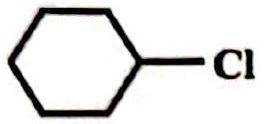
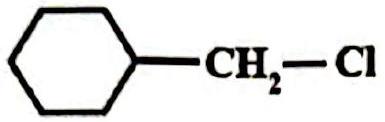
Answer the following questions: a) Why does racemisation occur in SN1? b) Why is ethanol less polar than water? c) Which one of the following in each pair is more reactive towards the SN2 reaction? (i) CH3CH2I or CH3CH2Cl (ii) chlorocyclohexane or (chloromethyl)cyclohexane OR c) Arrange the following in increasing order of their reactivity towards SN1 reactions: (i) 2-bromo-2-methylbutane, 1-bromopentane, 2-bromopentane (ii) 1-bromo-3-methylbutane, 2-bromo-2-methylbutane, 2-bromo-3-methylbutanePair (c)(ii): chlorocyclohexanePair (c)(ii): (chloromethyl)cyclohexane
Solution
(a) The SN1 intermediate is a planar sp2 carbocation; the nucleophile bonds from either face with nearly equal probability, forming both enantiomers — racemisation. (b) The bulky, non-polar ethyl group lowers the net molecular polarity and dilutes hydrogen bonding; ethanol's dielectric constant (24) is far below water's (79) — so ethanol is the less polar solvent. (c)(i) \textbf{CH3CH2I} — iodide is the better leaving group. (ii) \textbf{(Chloromethyl)cyclohexane} — the halogen is on a primary exocyclic carbon, less hindered than the ring (secondary) carbon of chlorocyclohexane. OR (SN1 follows carbocation stability, 1° < 2° < 3°): (i)