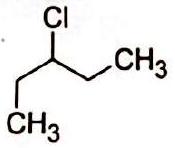
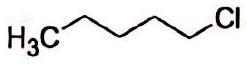
i) Why are haloalkanes more reactive than haloarenes towards nucleophilic substitution reactions? ii) Which of the two substances shown in the figure (3-chloropentane and 1-chloropentane) undergoes the SN1 reaction faster, and why?3-chloropentane1-chloropentane
Solution
(i) In haloarenes the halogen lone pair is delocalised into the ring, giving the C–X bond partial double-bond character; the carbon is also sp2 (more electronegative, shorter/stronger bond), and the electron-rich ring repels nucleophiles. Haloalkanes have a simple polar C(sp3)–X bond that nucleophiles attack easily — hence they are far more reactive. (ii) 3-Chloropentane ionises to the \textbf{secondary} carbocation CH3CH2\overset{+}{C}HCH2CH3, more stable than the primary cation from 1-chloropentane — so \textbf{3-chloropentane is faster in SN1}.
CBSE Class 12 Board · 2008 · All India · Subjective