CBSE Class 12 · 2017 · Haloalkanes and HaloarenesVery Short Answer

WhatsApp Email
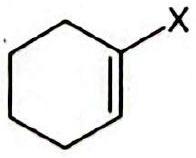
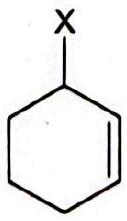
Of the two halides shown in the figure (3-halocyclohex-1-ene and 1-halocyclohex-1-ene), which is an example of an allylic halide?
Structure First halide (allylic)
First halide (allylic)
Structure Second halide (vinylic)
Second halide (vinylic)

Solution

An allylic halide carries the halogen on an sp carbon \textit{next to} a C=C double bond.
In 3-halocyclohex-1-ene, X is on the saturated carbon adjacent to the ring double bond — \textbf{allylic}.
In 1-halocyclohex-1-ene, X is attached directly to the sp carbon of the double bond — vinylic, not allylic.
CBSE Class 12 Board · 2017 · Subjective

More board questions on Haloalkanes and Haloarenes

  1. Auto-oxidation of chloroform in air and light produces a poisonous gas known as:
    CBSE 2024View solution →
  2. Assertion (A): Inversion of configuration is observed in the S2 reaction.
    Reason (R): The reaction proceeds with the formation of a carbocation.
    CBSE 2024View solution →
  3. Account for the following:
    (a) Haloalkanes react with AgCN to form isocyanides as the main product.
    (b) Allyl chloride shows high reactivity towards the S1 reaction.
    (c) Haloarenes are extremely less reactive towards nucleophilic substitution reactions.
    CBSE 2024View solution →
  4. Write equations for the following:
    a) oxidation of chloroform by air and light
    b) reaction of chlorobenzene with CHCl / anhydrous AlCl
    CBSE 2023View solution →
  5. The substitution reaction of an alkyl halide mainly occurs by the SN1 or SN2 mechanism. Whatever mechanism alkyl halides follow for the substitution reaction to occur, the polarity of the carbon-halogen bond is responsible for these substitution reactions. The rate of SN1 reactio …
    CBSE 2020View solution →
  6. The substitution reaction of an alkyl halide mainly occurs by the SN1 or SN2 mechanism. Whatever mechanism alkyl halides follow for the substitution reaction to occur, the polarity of the carbon-halogen bond is responsible for these substitution reactions. The rate of SN1 reactio …
    CBSE 2020View solution →