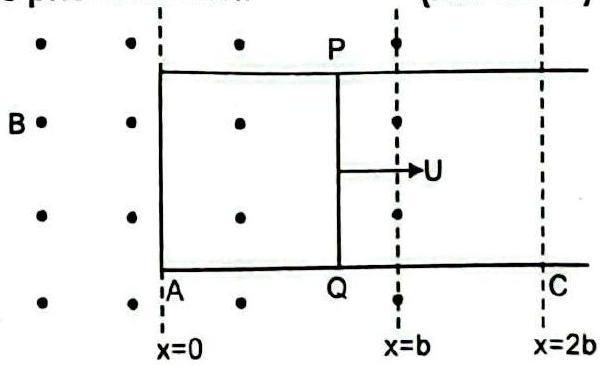
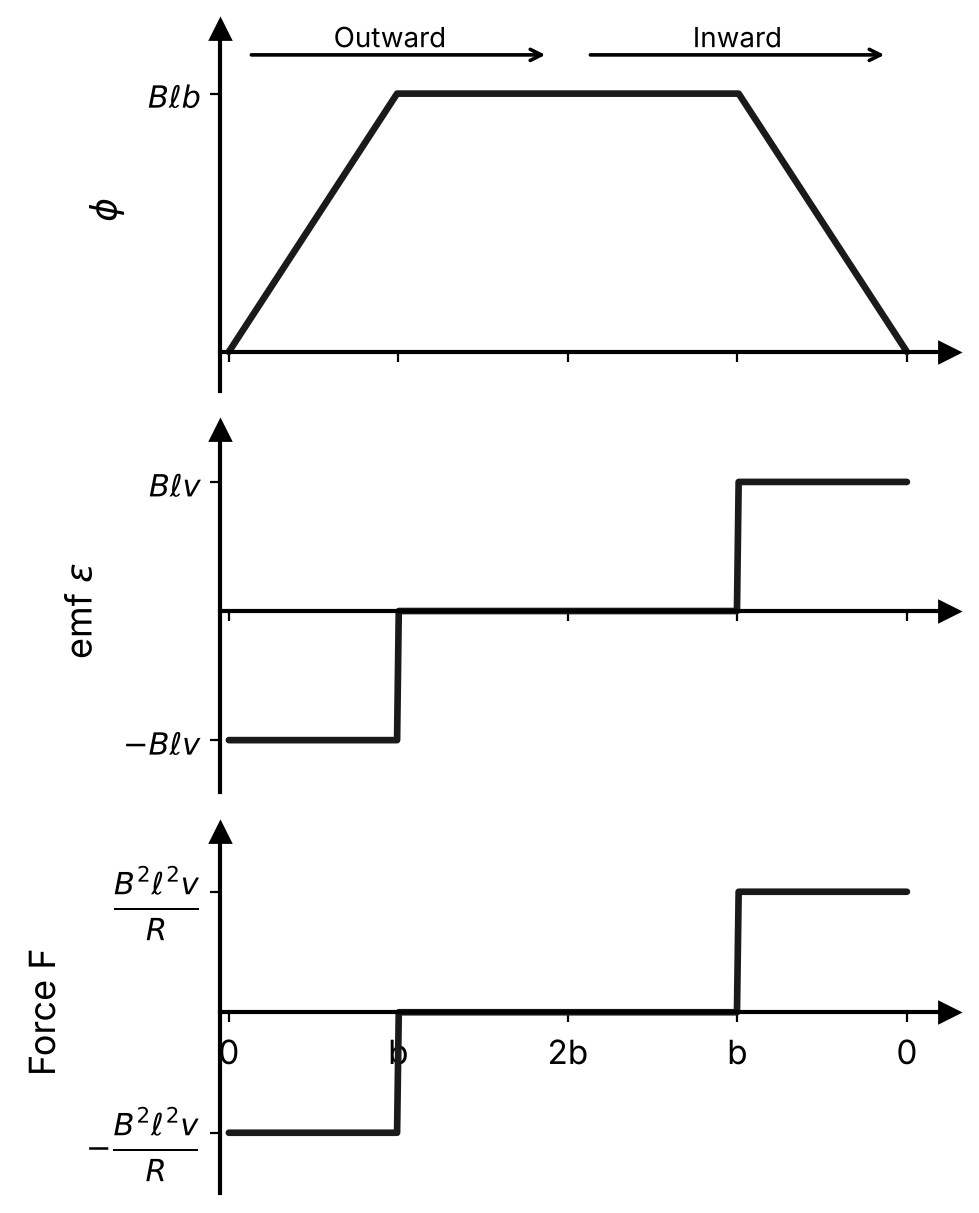
(a) When a bar magnet is pushed towards (or away from) a coil connected to a galvanometer, the pointer in the galvanometer deflects. Identify the phenomenon causing this deflection, write the factors on which the amount and direction of the deflection depend, and state the laws describing this phenomenon. (b) Sketch the change in flux, emf and force when a conducting rod PQ of resistance R and length ℓ moves freely to and fro between A and C with speed v on a rectangular conductor placed in a uniform magnetic field, as shown in the figure.
Solution
(a) The phenomenon is electromagnetic induction. The magnitude of the deflection depends on the speed of the magnet, the strength of its poles, the number of turns in the coil and the relative orientation; the direction of deflection depends on whether the magnet approaches or recedes and on which pole faces the coil. The governing laws are Faraday's laws (an emf is induced when flux changes, of magnitude ∣ε∣=dϕ/dt) and Lenz's law (the induced current opposes the change). (b) As PQ enters, the flux ϕ=Bℓx grows linearly with position, so during each sweep the flux is a straight ramp; when the rod reverses, the ramp reverses. The emf ε=−dϕ/dt=−Bℓv has constant magnitude but changes sign each time the rod reverses — a square wave. The current is i=Bℓv/R and the opposing force F=Biℓ=RB2ℓ2v likewise has constant magnitude and reverses with the direction of motion, always opposing it.
CBSE Class 12 Board · 2016 · All India · Subjective