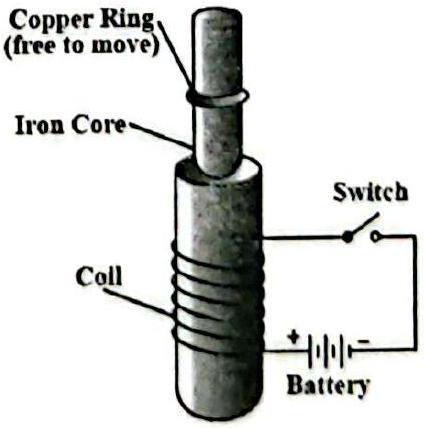
Consider the experimental set-up shown in the figure. This jumping-ring experiment is a demonstration of simple laws of physics: a conducting non-magnetic ring is placed over the vertical core of a solenoid, and when current is passed through the solenoid, the ring is thrown off. (i) Explain the reason for the jumping of the ring when the switch is closed. (ii) What will happen if the terminals of the battery are reversed and the switch is closed? Explain. (iii) Explain the two laws that help us understand this phenomenon.
Solution
(i) When the switch is closed, the current in the solenoid rises quickly, so the flux through the ring increases rapidly. By Faraday's law this induces a current in the ring, and by Lenz's law that current opposes the growing flux. The ring thus behaves like a magnet whose face repels the solenoid's field, and the upward repulsive force throws the ring off. (ii) If the battery terminals are reversed, both the solenoid's field and the induced ring current reverse together. The two fields are still in opposition, so the force remains repulsive and the ring jumps again. (iii) Two laws govern this: Faraday's law of electromagnetic induction (a changing flux through the ring induces an emf and current) and Lenz's law (the induced current opposes the change, giving the repulsion that lifts the ring).