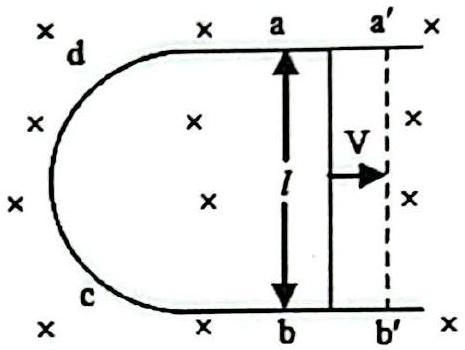
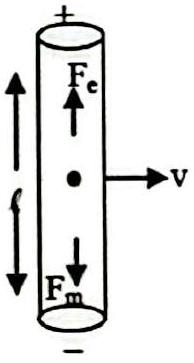
(a) A rod of length ℓ is moved horizontally with a uniform velocity v in a direction perpendicular to its length through a region in which a uniform magnetic field is acting vertically downward. Derive the expression for the emf induced across the ends of the rod. (b) How does one understand this motional emf by invoking the Lorentz force acting on the free charge carriers of the conductor? Explain.
Answer:ε=Bℓv; it arises from the magnetic (Lorentz) force on the free electrons.
Solution
(a) Let the rod slide on a U-shaped frame so that in time dt it sweeps an area dA=ℓ(vdt). The change of flux is
dϕ=BdA=Bℓvdt
so the induced emf is
ε=dtdϕ=Bℓv
ε=Bℓv
(b) A free electron in the moving rod experiences the magnetic force Fm=q(v×B), which pushes electrons to one end, leaving the other end positive. This charge separation builds an electric field E until the electric force balances the magnetic force: qE=qvB, i.e. E=vB. The potential difference across the ends is then ε=Eℓ=Bℓv, the same result, now seen as the work done per unit charge by the Lorentz force.