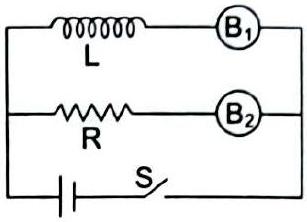
In a given circuit, an inductor L and a resistor R have identical resistance. Two similar electric lamps B1 and B2 are connected as shown. When the switch S is closed: (i) Which one of the lamps lights up earlier? (ii) Will the lamps be equally bright after some time? Justify your answer.
Answer: (i) B2 lights up earlier. (ii) Yes, both lamps become equally bright after some time.
Solution
The two branches are identical in resistance, so in the steady state each lamp carries the same current and glows equally. At the instant S is closed the branch with L opposes the growth of current through it (a back emf −Ldi/dt appears), so the current in B1 rises slowly while B2 (pure R) reaches its final value at once. Hence B2 lights up earlier. After a long time di/dt→0, the inductor behaves as a plain resistance equal to R, the two branches become identical, and both lamps are equally bright.