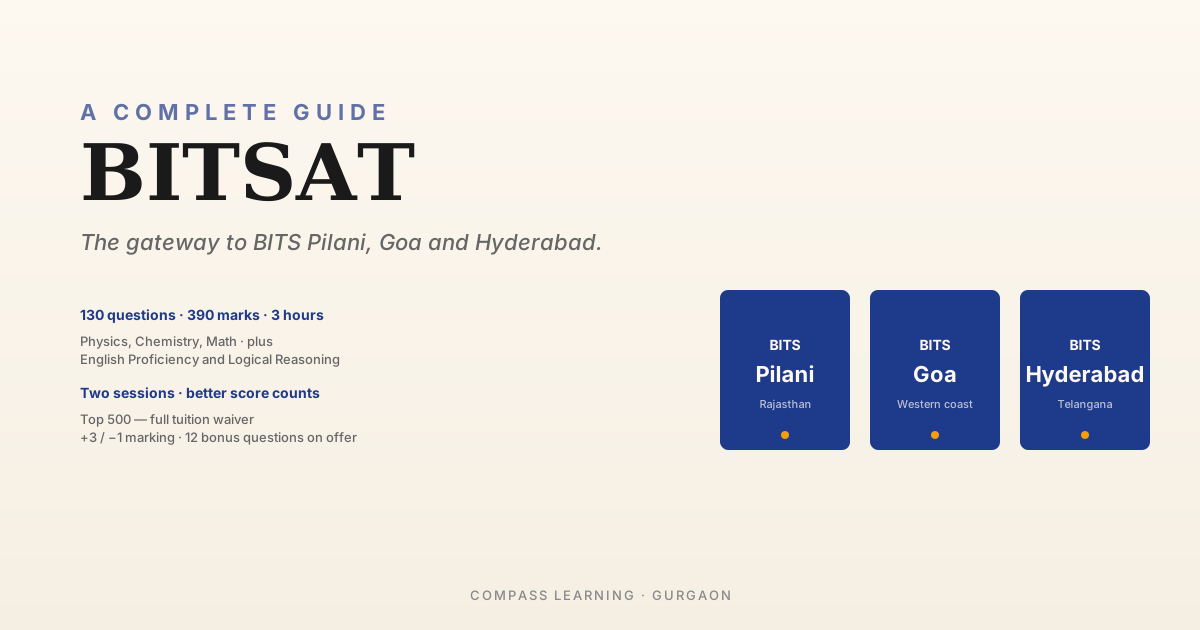
BITSAT — the Birla Institute of Technology and Science Admission Test — is the entrance exam for admission to BITS Pilani's three Indian campuses: Pilani (Rajasthan), Goa, and Hyderabad. For many JEE aspirants, BITSAT is the most natural second exam after JEE Main: same broad subjects, similar Class XI–XII syllabus base, and a degree at BITS that's genuinely competitive with the top NITs.
This article covers BITSAT in detail — what the paper looks like, who can write it, how the two sessions work, and the small features that make BITSAT genuinely different from JEE Main. We've kept it evergreen — for the current year's exact dates, see our annual update article.
Note: This article is written to be evergreen, but specific dates, fees, eligibility thresholds, and procedural details are set each year by the relevant authority — NTA, JoSAA, BITS Pilani, HSTES, or the institute concerned. Always cross-check the latest official notification before acting on anything time-sensitive.
The campuses, and what BITSAT admits you to
BITSAT is the single entrance for integrated First Degree programmes across all four BITS campuses — Pilani, Goa, Hyderabad, and Dubai. The programmes include:
- B.E. (engineering) in various branches — Computer Science, Electronics & Communication, Electrical & Electronics, Mechanical, Chemical, Civil, Manufacturing, and others depending on the campus
- B.Pharm
- Integrated M.Sc. programmes in subjects like Mathematics, Physics, Chemistry, Biological Sciences, Economics, and General Studies
The same BITSAT score is used across all campuses. During admission, students rank their preferred campus-branch combinations, and the institute allocates seats based on BITSAT score and student preference.
A note on the campuses: BITS Pilani (the original) is the most well-known, but BITS Goa and BITS Hyderabad have grown into excellent institutions in their own right. Cutoffs at all three for CS are competitive; differences between the campuses are real but not as wide as the brand difference might suggest.
Exam structure
BITSAT is a computer-based test of 3 hours, conducted in two sessions each year — usually one in May and one in June. A candidate can attempt one session, or both; if both are attempted, the better score counts.
The paper has five sections:
| Section | Questions |
|---|---|
| Physics | 30 |
| Chemistry | 30 |
| English Proficiency | 10 |
| Logical Reasoning | 20 |
| Mathematics (or Biology, for B.Pharm) | 40 |
| Total | 130 |
Each question is multiple-choice with four options. Marking is straightforward:
- +3 for a correct answer
- −1 for a wrong answer
- 0 for an unattempted question
Total marks: 390. Maximum BITSAT scores tend to be in the 380s or low 390s — high enough that being close to perfect matters.
The BITSAT bonus — and what most students miss
This is the feature that genuinely separates BITSAT from other entrance exams.
If a candidate finishes all 130 questions before the 3-hour time limit, they can opt to attempt 12 additional bonus questions. These bonus questions come from Physics, Chemistry, and Mathematics (or Biology) — three or four from each subject. They follow the same +3 / −1 marking. Critically: once you opt for the bonus questions, you cannot go back and change your earlier answers.
So the strategic question is: do you risk losing access to your existing answers in exchange for a shot at 36 extra marks?
For students who are confident in their attempts and have time to spare, the bonus is an opportunity. For students who are uncertain about even one or two answers in the main 130, going back to review is usually more valuable than chasing additional marks. The decision needs to be made in real time, on the day.
A common pattern among well-prepared candidates: aim to finish the main 130 with about 25–30 minutes left, use that buffer to lock in confident reviews of the harder questions, and then attempt the bonus only if the buffer is comfortable.
The syllabus
BITSAT's syllabus is based on the NCERT Class XI and Class XII curriculum for Physics, Chemistry, and Mathematics (or Biology) — broadly the same content as JEE Main. The exam is well-suited for a student who's preparing for JEE Main; the bulk of preparation transfers.
The two additional sections — English Proficiency and Logical Reasoning — are where BITSAT differs:
- English Proficiency (10 questions) tests grammar, vocabulary, reading comprehension, sentence completion, and synonyms/antonyms. Class XI–XII English standard, but more focused on precision than literary depth.
- Logical Reasoning (20 questions) tests verbal and non-verbal reasoning — series, analogies, figure patterns, statement-and-conclusion, syllogisms, and the like. Closer to the kind of questions that appear in management entrance exams.
These two sections together account for 30 of the 130 questions — almost a quarter of the paper. Students preparing only for JEE Main sometimes underprepare here; a few weeks of focused practice on these sections, starting around March or April, is usually enough.
Eligibility
The eligibility conditions for BITSAT have a few specifics worth noting:
- Class XII pass with Physics, Chemistry, and Mathematics (for B.E. programmes). For B.Pharm, Biology in place of (or in addition to) Mathematics.
- At least 75% aggregate in Physics, Chemistry, and Mathematics (or PCB), with minimum 60% in each individual subject.
- The candidate must have passed Class XII in 2025 or 2026 (or be appearing in 2026) — BITS specifies a recent year-of-passing window.
- English as a subject in Class XII is required.
- A recent eligibility change worth noting: candidates who reappear for Class XII to improve their marks are no longer eligible for BITSAT. The original Class XII year-of-passing applies. This is different from JEE Main and Advanced, which generally allow such candidates.
Each year's BITSAT information bulletin is the authoritative source for these rules; check the latest before applying.
Two sessions, two attempts
BITSAT's two-session model is similar in spirit to JEE Main's:
- Session 1 is typically held in May.
- Session 2 is typically held in June.
- A candidate can register for one session or both. If both are taken, the better score is used for admission.
A small administrative detail: you decide whether to register for both sessions at the time of the initial application. Adding Session 2 after Session 1's result requires a separate registration window, and isn't always available — most students who want to keep Session 2 open register for both upfront.
The exam itself is computer-based, with slot booking — once you register, you select your preferred date and time slot from the available windows. Slot booking is on a first-come-first-served basis, so applying early gives more choice.
The Tuition Blind Admission scheme — top 500
BITS announced (in recent years) a scholarship scheme called Tuition Blind Admission: the top 500 rank holders in BITSAT are admitted with a full tuition fee scholarship for all four years of their degree.
This is a meaningful financial benefit — BITS Pilani's fees are substantially higher than most government engineering colleges, so a full tuition waiver makes top-rank BITSAT entry financially comparable to NITs and IITs. The scheme details may change year-to-year; check the official BITS Pilani admission page for the current year's policy.
Application process
BITSAT applications usually open in late January and run through April. The form is on bitsadmission.com. You'll need:
- A scanned photograph and signature in the required format (see our JEE Main and Engineering Entrance Documents: The Complete Checklist)
- Class XII details (board, year, marks if available)
- Aadhaar or other ID
- Payment of the application fee (varies by category and number of sessions)
After registration, you'll get an application number. The slot booking window opens later, and you'll need to log back in to pick your exam date and centre.
Admission process after BITSAT result
Once results are out:
- BITS releases a cutoff for each campus-branch combination — typically a BITSAT score below which admission is not possible.
- Eligible candidates fill an admission preference form, listing campus-branch combinations in order of preference.
- BITS allocates admissions in rounds — typically two or three iterations — based on score and preference.
- Admitted students confirm by paying the admission fee.
The admission process is BITS's own — it does not go through JoSAA. So a student can have a JoSAA seat and a BITS admission, and choose between them.
How BITSAT compares to JEE Main
A quick orientation, since most BITSAT candidates are also JEE Main candidates:
- Same broad syllabus in PCM, but BITSAT also has English and Logical Reasoning.
- Speed-based. BITSAT gives you slightly less time per question than JEE Main, on average. Time discipline matters.
- Lower stakes on a single question. With 130 questions and +3 marking, individual questions matter less than they do in Advanced. Volume and accuracy matter more.
- No percentile normalisation. BITSAT uses raw scores. The cutoff for a given campus-branch is in terms of marks (e.g., "350+ for BITS Pilani CS").
- Single test admission. BITSAT is conducted once a year (per session), and admission is direct based on the score. No multi-stage process like JEE Main → Advanced → JoSAA.
How the year flows for BITSAT
A typical timeline:
- January–April: Application window.
- April–May: Admit card; slot booking.
- May (Session 1) and June (Session 2): Exam.
- June: Results.
- June–July: Admission preference forms; cutoffs; admission rounds.
- August: Academic session begins.
For this year's exact dates, see our annual update article.
Where to read next
For the bigger picture: JEE, BITSAT and Beyond: A Complete Guide to Engineering Admissions in India.
For comparison with JEE: JEE Main Complete Guide and JEE Main vs JEE Advanced: What's the Real Difference.
For documents and forms: JEE Main and Engineering Entrance Documents: The Complete Checklist.
Have questions about your specific situation?
We're at Ardee City, Sector 52, Gurgaon. Drop by anytime, or give us a call. Always happy to chat through strategy with parents and students — no pitch, no pressure, just a conversation about what makes sense for you.