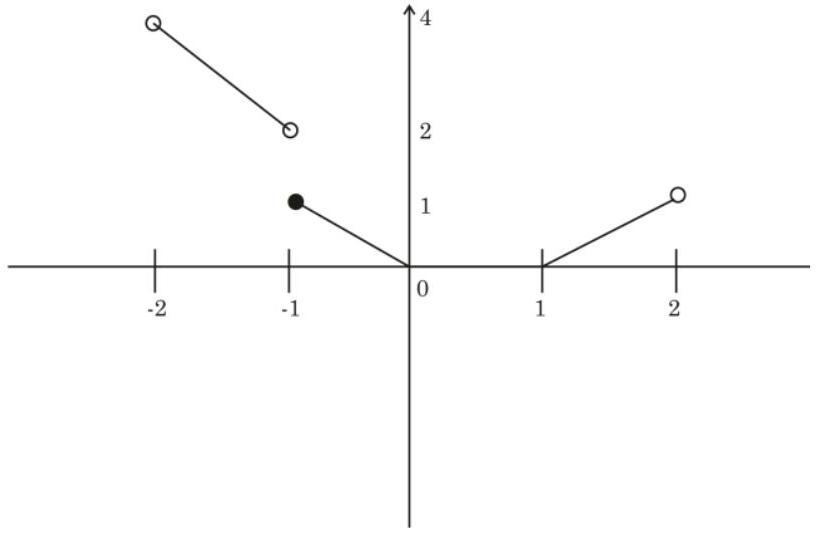
Where [x] denotes the greatest integer function. If m and n respectively are the number of points in (−2,2) at which y=∣f(x)∣ is not continuous and not differentiable, then m+n is equal to ______.
Answer: 4
Solution
On each unit interval the greatest-integer value is constant, so f(x)=−2x on (−2,−1), f(x)=−x on [−1,0), f(x)=0 on [0,1) and f(x)=x−1 on [1,2). Each of these expressions is already non-negative, so ∣f(x)∣ equals the same four expressions. As x→−1−, ∣f∣→−2(−1)=2, whereas ∣f(−1)∣=1, so ∣f∣ has a jump and is discontinuous at x=−1; at x=0 and x=1 the adjacent pieces meet at the value 0, so ∣f∣ is continuous there. Thus it is discontinuous at exactly one point and m=1. For differentiability, ∣f∣ fails at the discontinuity x=−1, and it has corners at x=0 (left slope −1, right slope 0) and at x=1 (left slope 0, right slope 1). Hence n=3, and m+n=4.