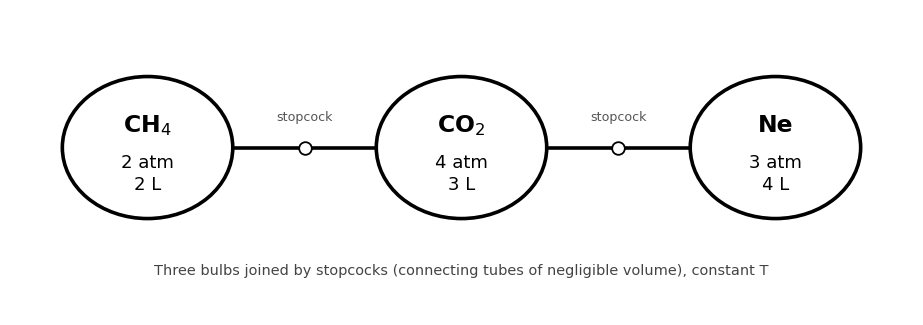
Three bulbs are filled with CHX4, COX2 and Ne as shown in the picture. The bulbs are connected through pipes of zero volume. When the stopcocks are opened and the temperature is kept constant throughout, the pressure of the system is found to be ______ atm. (Nearest integer) [⚠ FIGURE REFERENCED BUT NONE ATTACHED — verify against source PDF]
[Reaction scheme / given data] Three spherical glass bulbs stand in a row on a common horizontal manifold, joined left-to-right by short connecting tubes. Two stopcocks (small circles drawn on the connecting necks, one between bulb 1 and bulb 2, one between bulb 2 and bulb 3) isolate the bulbs until opened. The pipes connecting the bulbs are stated to be of zero volume. Each bulb carries a three-line label giving its pressure, volume and gas. Left bulb: P = 2 atm, V = 2 L, CH4(g). Middle bulb: P = 4 atm, V = 3 L, CO2(g). Right bulb: P = 3 atm, V = 4 L, Ne(g).
Answer: 3
Solution
Because the temperature is held constant and the connecting pipes have zero volume, opening the stopcocks simply lets the three gases share one combined volume while the total number of moles is conserved. Writing PV=nRT for each bulb at the same T, the mole content of each is proportional to its PV product: for CHX4, P1V1=2×2=4; for COX2, P2V2=4×3=12; for Ne, P3V3=3×4=12. The total available volume is VT=2+3+4=9L, so from nTRT=∑PiVi the common final pressure is PT=VT∑PiVi=94+12+12=928=3.11atm. Rounded to the nearest integer, the pressure of the system is 3atm.