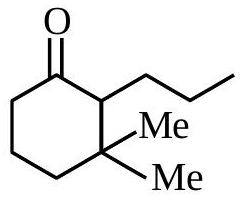
(A)3,3-dimethyl-2-propylcyclohexan-1-one (cyclohexanone bearing an n-propyl group on the alpha-carbon C2 and a gem-dimethyl at the adjacent C3)✓ Correct
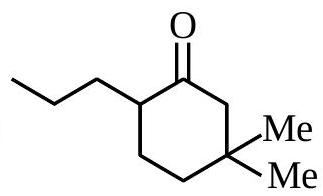
(B)5,5-dimethyl-2-propylcyclohexan-1-one (cyclohexanone with the n-propyl on one alpha-carbon and the gem-dimethyl on the far side of the ring, C5 - wrong regiochemistry)
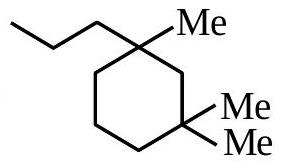
(C)1-methyl-3,3-dimethyl-1-propylcyclohexane (fully saturated hydrocarbon, no carbonyl; over-addition product retaining no C=O)
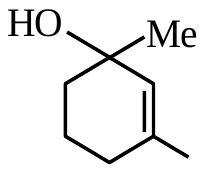
(D)1,3-dimethylcyclohex-2-en-1-ol (tertiary allylic alcohol from direct 1,2-addition, double bond retained)
Answer: (A)
Solution
Here the copper(I) iodide is the decisive clue. A simple Grignard reagent adds to the carbonyl in a 1,2 fashion, but in the presence of CuI the methyl nucleophile is delivered in a conjugate 1,4 fashion to the β-carbon of the enone. Our starting enone is 3-methylcyclohex-2-en-1-one, so the methyl adds to the already methyl-bearing β-carbon (C3) and creates a quaternary gem-dimethyl centre there. What results from this addition is not a neutral ketone yet but a magnesium enolate, with the negative charge delocalised onto the α-carbon (C2). That nucleophilic α-carbon is then trapped by n-propyl iodide in an SN2 alkylation, installing the n-propyl group right next to the new gem-dimethyl carbon. The carbonyl is regenerated on workup, so the ring stays a ketone; the alcohol and the fully saturated hydrocarbon are therefore ruled out. The major product is 3,3-dimethyl-2-propylcyclohexan-1-one.
JEE Main · 2023 · 06 Apr 2023 · Shift 2 · Single correct option