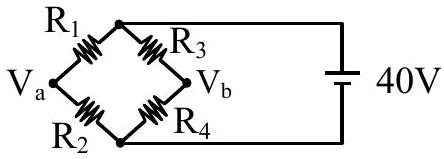
A wheatstone bridge is initially at room temperature and all arms of the bridge have same value of resistances (R1=R2=R3=R4). When R3 resistance is heated to some temperature, its resistance value has gone up by 10%. The potential difference (Va−Vb) (after R3 is heated) is ______ V.
(A)1.05
(B)0
(C)0.95✓ Correct
(D)2
Answer: (C)
Solution
The bridge is supplied with 40 V across its top and bottom nodes. Point a is the junction of R1 (top) and R2 (bottom), and point b is the junction of R3 (top) and R4 (bottom); each branch acts as a potential divider. Initially all arms equal R, so Va=Vb=20 V and the bridge is balanced. Heating R3 raises it to 1.1R, so Vb=40×R3+R4R4=40×1.1R+RR=2.140≈19.05 V, while Va stays at 20 V. Hence Va−Vb=20−19.05=0.95 V.
JEE Main · 2026 · 28 Jan 2026 · Shift 2 · Single correct option