JEE Main · 2026 · 28 Jan 2026 · Shift 1 · Atomic Structure

WhatsApp Email
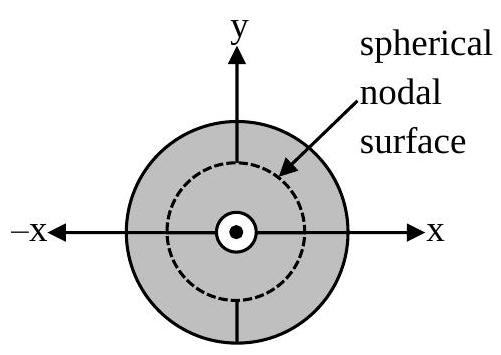
Figure 1. electron probability density for 2s orbital

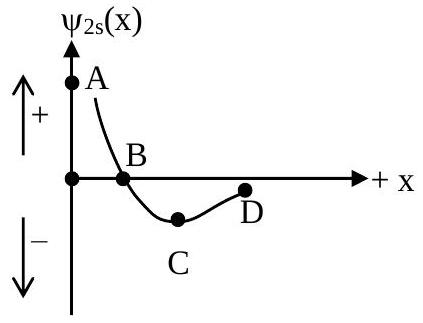
Figure 2. wave function for 2s orbital

Which of the following point in Figure 2 most accurately represents the nodal surface as shown in Figure 1?
Structure Figure 1
Figure 1
Structure Figure 2
Figure 2
  1. (A)B✓ Correct
  2. (B)D
  3. (C)C
  4. (D)A

Answer: (A)

Solution

A spherical (radial) node is the surface where the radial wave function passes through zero, , so the electron probability density is zero there as well. In the plot of against distance the curve starts positive near the nucleus and then cuts the axis before dipping negative; the point where it crosses zero is point B. Point B represents the nodal surface.

JEE Main · 2026 · 28 Jan 2026 · Shift 1 · Single correct option
More JEE Main questions on Atomic Structure

  1. Given below are two statements:

    Statement I: When an electric discharge is passed through gaseous hydrogen, the hydrogen molecules dissociate and the energetically excited hydrogen atoms produce electromagnetic radiation of discrete frequencies.

    Statement II: The frequency of s …
    JEE Main 2026View solution →
  2. The energy required by electrons, present in the first Bohr orbit of hydrogen atom to be excited to second Bohr orbit is ____ .

    Given : .
    JEE Main 2026View solution →
  3. Consider the following spectral lines for atomic hydrogen:
    A. First line of Paschen series
    B. Second line of Balmer series
    C. Third line of Paschen series
    D. Fourth line of Bracket series

    The correct arrangement of the above lines in ascending order of energy is:
    JEE Main 2026View solution →
  4. The energy of first (lowest) Balmer line of H atom is x J. The energy (in J) of second Balmer line of H atom is :
    JEE Main 2026View solution →
  5. Which of the following statements regarding the energy of the stationary state is true in the following one-electron system ?
    JEE Main 2026View solution →
  6. Given,
    (A)
    (B)

    The maximum number of electron(s) in an atom that can have the quantum numbers as given in (A) and (B) respectively are :
    JEE Main 2026View solution →