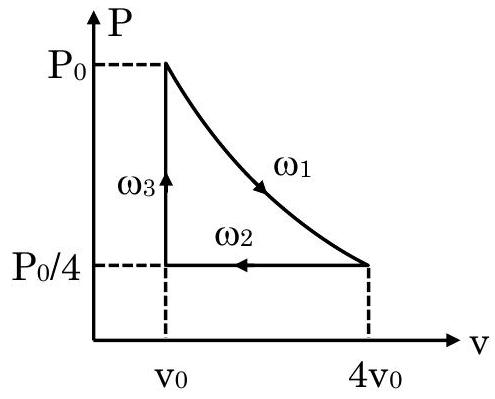
An ideal gas exists in a state with pressure P0, volume V0. It is isothermally expanded to 4 times of its initial volume (V0), then isobarically compressed to its original volume. Finally the system is heated isochorically to bring it to its initial state. The amount of heat exchanged in this process is :
(A)P0V0(2ln2−0.75)✓ Correct
(B)P0V0(ln2−0.75)
(C)P0V0(ln2−0.25)
(D)P0V0(2ln2−0.25)
Answer: (A)
Solution
Over one complete cycle the internal energy returns to its starting value, so the net heat exchanged equals the net work done. The isothermal expansion from V0 to 4V0 gives W1=P0V0ln4=2P0V0ln2. At the end of that step the pressure has fallen to P0/4, and the isobaric compression back to V0 gives W2=4P0(V0−4V0)=−43P0V0. The isochoric step that restores the pressure does no work. Adding these, the heat exchanged over the cycle is P0V0(2ln2−0.75).
JEE Main · 2025 · 03 Apr 2025 · Shift 2 · Single correct option