Let Y=Y(X) be a curve lying in the first quadrant such that the area enclosed by the line Y−y=Y′(x)(X−x) and the co-ordinate axes, where ( x,y ) is any point on the curve, is always 2Y′(x)−y2+1,Y′(x)=0. If Y(1)=1, then 12Y(2) equals
Answer: 20
Solution
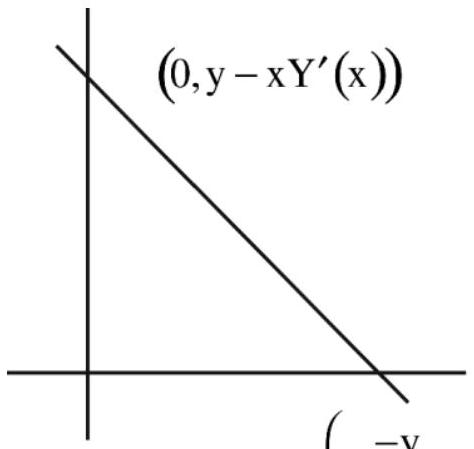
At a point (x,y) on the curve, the tangent line is Y−y=Y′(x)(X−x), where Y′(x) denotes dxdy; write p=Y′(x).
Its intercepts: setting Y=0 gives the X-intercept x−py; setting X=0 gives the Y-intercept y−xp.
The enclosed triangle has area 21(x−py)(y−xp)=21(2xy−x2p−py2)=xy−2x2p−2py2.
Setting this equal to −2py2+1, the −2py2 terms cancel, leaving xy−2x2p=1⇒x2p=2xy−2⇒p=dxdy=x2y−x22.
This is linear: dxdy−x2y=−x22, with integrating factor x−2: dxd(x2y)=−x42⇒x2y=3x32+C⇒y=3x2+Cx2.
Using Y(1)=1: 1=32+C⇒C=31, so Y(X)=3X2+3X2.
Y(2)=31+34=35, so 12Y(2)=12×35=20.
JEE Main · 2024 · 30 Jan 2024 · Shift 2 · Integer answer