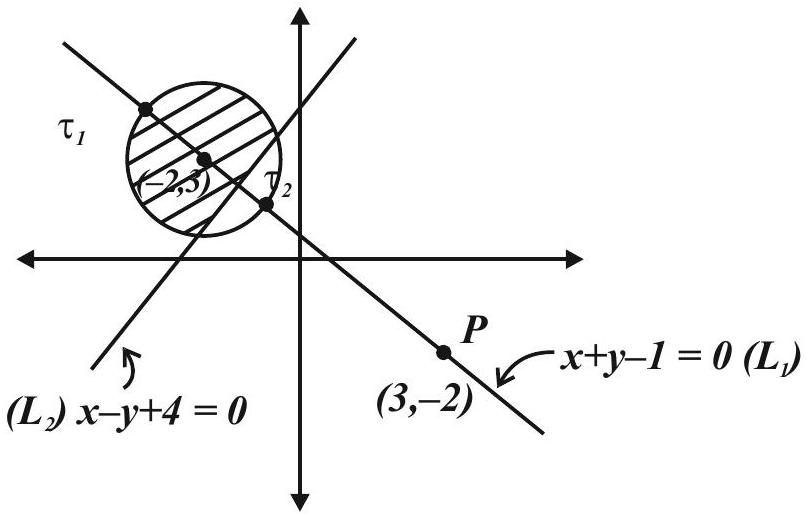
Let P={z∈C:∣z+2−3i∣≤1} and Q={z∈C:z(1+i)+z(1−i)≤−8}. Let in P∩Q, ∣z−3+2i∣ be maximum and minimum at z1 and z2 respectively. If ∣z1∣2+2∣z2∣2=α+β2, where α,β are integers, then α+β equals ______.
Answer: 36
Solution
P={z:∣z+2−3i∣≤1}: closed disc, centre (−2,3), radius 1. Q: writing z=x+iy, z(1+i)+zˉ(1−i)=(x−y)+i(x+y)+(x−y)−i(x+y)=2(x−y), so Q is 2(x−y)≤−8, i.e. y≥x+4 — the half-plane on or above the line ℓ:x−y+4=0.
Distance from the disc's centre (−2,3) to ℓ: 2∣−2−3+4∣=21<1, so ℓ cuts through the disc; since the centre itself satisfies 3≥−2+4, P∩Q is the larger part of the disc.
We need the extremes of ∣z−(3−2i)∣, i.e. distance to the fixed point A=(3,−2), over P∩Q.
*Maximum:* Unconstrained, the farthest point of the disc from A lies diametrically opposite A across the centre: direction from centre to A is 521(5,−5)=21(1,−1), so the farthest point is
z1=(−2,3)−1⋅21(1,−1)=(−2−21,3+21)
Check feasibility: y−x=5+2≥4 — satisfies Q. So this point is the true (constrained) maximum:
*Minimum:* The unconstrained nearest point of the disc to A, (−2+21,3−21), gives y−x=5−2≈3.59<4 — infeasible (outside Q). Since A itself lies on the far side of ℓ from the feasible region (yA−xA=−5<4), the nearest feasible point is the foot of the perpendicular from A onto ℓ:
This point's distance from the disc's centre is 0.52+0.52=21<1, so it lies inside the disc — a valid point of P∩Q, confirming it is the true minimum:
∣z2∣2=(23)2+(25)2=49+425=434=217
∣z1∣2+2∣z2∣2=(14+52)+2(217)=14+52+17=31+52
Matching α+β2: α=31,β=5, so α+β=36.
JEE Main · 2024 · 01 Feb 2024 · Shift 1 · Integer answer