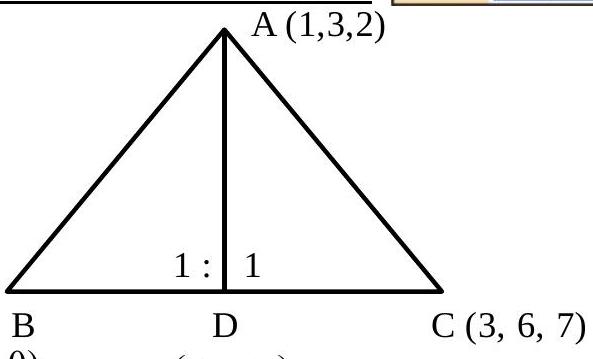
Consider a △ABC where A(1,3,2),B(−2,8,0) and C(3,6,7). If the angle bisector of ∠BAC meets the line BC at D , then the length of the projection of the vector AD on the vector AC is:
Since AB=AC, the triangle is isosceles at A, and the internal angle bisector of ∠BAC meets BC at its midpoint (the angle-bisector theorem gives BD:DC=AB:AC=1:1):
D=(2−2+3,28+6,20+7)=(21,7,27).
AD=D−A=(−21,4,23),AC=C−A=(2,3,5),∣AC∣=38.
Length of projection of AD on AC:
∣AC∣AD⋅AC=38−1+12+215=38237=23837.
JEE Main · 2024 · 01 Feb 2024 · Shift 2 · Single correct option