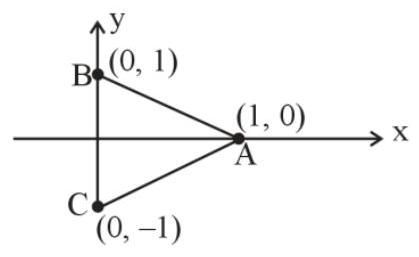
If S={z∈C:∣z−i∣=∣z+i∣=∣z−1∣}, then, n(S) is:(A)1✓ Correct(B)0(C)3(D)2Answer: (A)Solution∣z−i∣=∣z+i∣=∣z−1∣ says z is equidistant from the three non-collinear points i,−i,1. Such a point is unique: the circumcentre of the triangle they form. So n(S)=1.JEE Main · 2024 · 27 Jan 2024 · Shift 1 · Single correct option