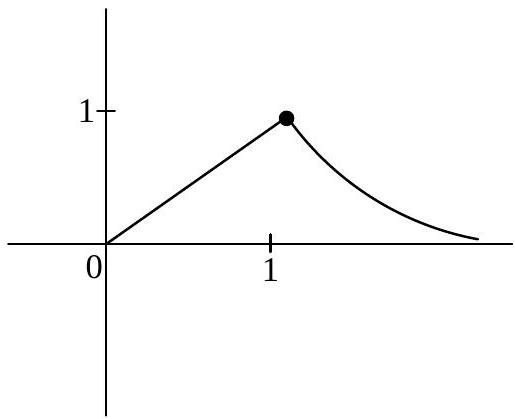
Consider the function f:(0,∞)→R defined by f(x)=e−∣logex∣. If m and n be respectively the number of points at which f is not continuous and f is not differentiable, then m+n is
(A)0
(B)3
(C)1✓ Correct
(D)2
Answer: (C)
Solution
f(x)=e−∣logex∣ on (0,∞).
For 0<x<1: logex<0, so ∣logex∣=−logex, giving f(x)=elogex=x.
For x≥1: logex≥0, so f(x)=e−logex=x1.
Both pieces agree at x=1 (both give 1), and each piece is continuous on its own domain, so f is continuous everywhere on (0,∞): m=0.
Checking differentiability at x=1: the left-hand derivative (from f(x)=x) is 1; the right-hand derivative (from f(x)=1/x) is −1/x2 at x=1, i.e. −1. These are unequal, so f is not differentiable at x=1; this is the only such point, so n=1.
m+n=0+1=1.
JEE Main · 2024 · 31 Jan 2024 · Shift 2 · Single correct option