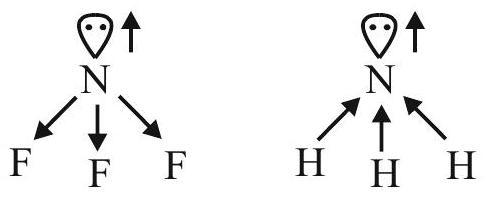
Statement-I: Since fluorine is more electronegative than nitrogen, the net dipole moment of NF3 is greater than NH3. Statement-II: In NH3, the orbital dipole due to lone pair and the dipole moment of NH bonds are in opposite direction, but in NF3 the orbital dipole due to lone pair and dipole moments of N-F bonds are in same direction.
In the light of the above statements. Choose the most appropriate from the options given below.
(A)Statement I is true but Statement II is false.
(B)Both Statement I and Statement II are false.✓ Correct
(C)Both statement I and Statement II is are true.
(D)Statement I is false but Statement II is are true.
Answer: (B)
Solution
In NH3, the lone pair on nitrogen and the three polar N–H bonds (bond dipole pointing towards the more electronegative N) both act in roughly the same direction, so they reinforce, giving a resultant dipole moment of about 1.46 D. In NF3, the N–F bond dipoles point from N towards the more electronegative F, i.e. away from nitrogen, opposing the lone-pair dipole that still points away from the N–F bonding density towards N; the two largely cancel, so NF3 has a much smaller net dipole moment (about 0.24 D) than NH3 — Statement I is false. Statement II reverses this: it claims the lone pair and bond dipoles oppose in NH3 and reinforce in NF3, the opposite of the actual situation, so it is also false. Both statements are false.
JEE Main · 2024 · 30 Jan 2024 · Shift 2 · Single correct option