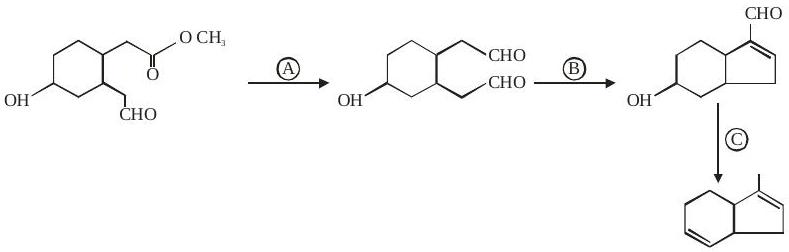
The sequence converts an ester group to an aldehyde, carries out an intramolecular aldol condensation, and then removes the newly formed carbonyl completely.
Step A: DIBAL-H at low temperature is a selective reducing agent that reduces an ester only as far as the aldehyde, stopping there rather than over-reducing to the alcohol the way LiAlH4 would.
Step B: alcoholic NaOH promotes an intramolecular aldol condensation between the aldehyde groups now present on the molecule, forming a new C=C bond with loss of water; alcoholic base favours this condensation (elimination) product over the simple aldol addition product that aqueous base would give.
Step C: Zn/HCl (Clemmensen reduction) reduces the remaining carbonyl completely to a CH2 group under acidic conditions, which is required here since the molecule carries functionality that basic Wolff–Kishner conditions would not leave intact.
The reagent set is A = DIBAL-H, B = alcoholic NaOH, C = Zn/HCl.
JEE Main · 2024 · 29 Jan 2024 · Shift 2 · Single correct option