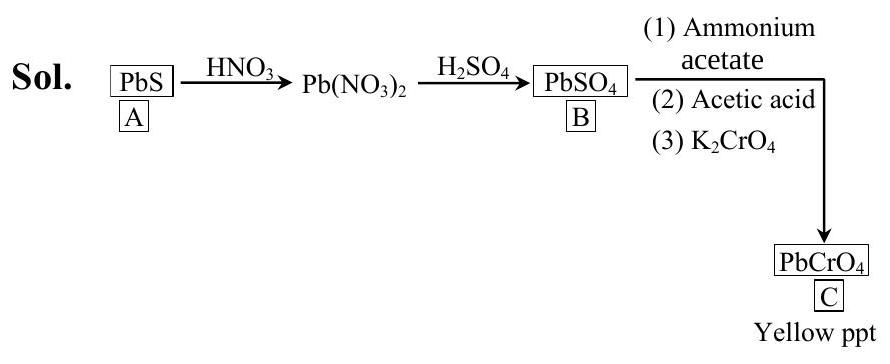
Identify A, B and C in the given below reaction sequence
(1) Ammonium acetate (2) Acetic acid (3) K2CrO4
C → Yellow ppt
(A)PbCl2,PbSO4,PbCrO4
(B)PbS,PbSO4,PbCrO4✓ Correct
(C)PbS,PbSO4,Pb(CH3COO)2
(D)PbCl2,Pb(SO4)2,PbCrO4
Answer: (B)
Solution
This is the qualitative separation and confirmation sequence for lead. Treating the black precipitate of lead sulfide, PbS (A), with hot dilute HNOX3 oxidises it to soluble Pb(NOX3)X2; adding HX2SOX4 then throws down insoluble white PbSOX4 (B). PbSOX4 does not dissolve in dilute acids, but ammonium acetate solubilises it by forming a soluble lead–acetate species; acetic acid keeps this solution buffered without precipitating the lead prematurely. Adding KX2CrOX4 to this solution precipitates PbCrOX4 (C), the characteristic yellow lead chromate used as a confirmatory test for PbX2+. The sequence PbSPbSOX4PbCrOX4 identifies A, B and C.
JEE Main · 2025 · 23 Jan 2025 · Shift 2 · Single correct option